



The Cosmic Speed Limit
It all starts with a simple, universal rule: nothing travels faster than light. But even at its incredible speed—roughly 300,000 kilometres per second—light still takes time to cross the unfathomable distances of space. Think of it like this: if you’re
video-calling a friend in another country, there’s a tiny lag. The information isn't instant. Now, imagine that lag stretching over years, centuries, or even millennia. That’s what happens with starlight. The distance light travels in one year is called a light-year, which is about 9.5 trillion kilometres. When we say a star is 10 light-years away, we mean the light we are seeing tonight began its journey 10 years ago. The star you’re looking at is, in a way, the star as it was a decade in the past.
Our Closest Neighbours, Our Recent Past
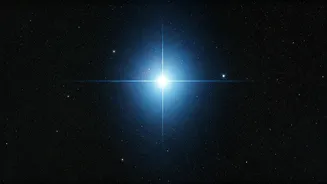
Let’s start close to home. The nearest star system to us after the Sun is Alpha Centauri. Its closest star, Proxima Centauri, is about 4.2 light-years away. This means the faint reddish glow from Proxima Centauri that reaches your eyes tonight actually left the star over four years ago. When that light began its journey, perhaps you were in a different job, or your favourite cricket team had a different captain. Now consider Sirius, the brightest star in our night sky, often called the 'Dog Star'. It’s about 8.6 light-years away. The brilliant sparkle you see from Sirius is a snapshot from nearly nine years in the past. It’s a message in a bottle, floating across the cosmic ocean for almost a decade before finally reaching us.
Looking Back Through Human History
This effect becomes even more profound as we look at more distant stars. Take Polaris, the North Star, which has guided travellers for centuries. It sits approximately 433 light-years from Earth. The light we see from Polaris tonight started its journey around the year 1591. While that light was travelling, the Mughal Empire was flourishing under Emperor Akbar in India, and Shakespeare was writing his first plays in England. The star itself might look different now—it might have changed in brightness or even exploded (though unlikely for Polaris)—but we wouldn’t know for another 433 years. Every star in a constellation tells a different story from a different era. The constellation of Orion, for instance, is a mix of time periods. The light from Betelgeuse is over 640 years old, while the light from Rigel is around 860 years old. You are seeing a collage of history in a single glance.
Gazing at Ancient Worlds
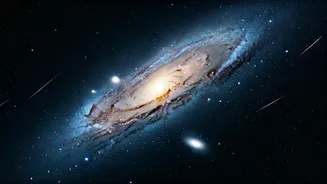
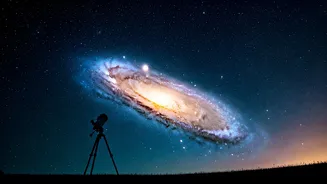
The most mind-bending part of this cosmic time travel isn't limited to stars in our own galaxy. On a clear, dark night, far from city lights, you might be able to spot a faint, fuzzy patch in the sky. This is the Andromeda Galaxy, the closest major galaxy to our own Milky Way. It is a staggering 2.5 million light-years away. The light you are seeing from that 'faint patch' is 2.5 million years old. When that light left the Andromeda Galaxy, modern humans (Homo sapiens) did not yet exist on Earth. Our early ancestors, like Homo habilis, were just beginning to walk the planet. You are, quite literally, looking at prehistoric light. The photons hitting your retina began their journey long before the first human civilizations, the pyramids, or any recorded history.