




The Cotton Candy Worlds
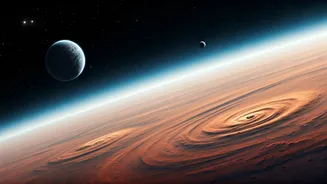
We once thought planets came in two basic models: small and rocky like Earth, or huge and gaseous like Jupiter. The latest discoveries have shattered that simple view. Astronomers are now finding planets with densities so low they've been compared to
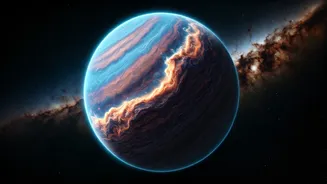
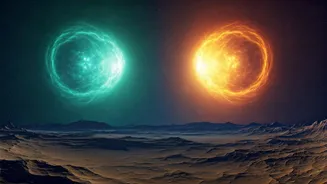
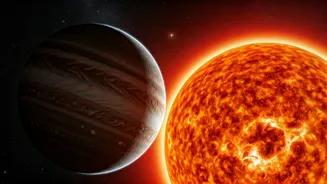
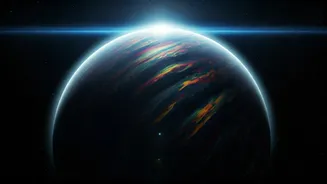
cotton candy. Recently, a pair of these 'super-puff' planets, named TOI-791b and TOI-791c, were confirmed orbiting a distant star. They are both roughly the size of Jupiter, but possess only a tiny fraction of its mass, making them astronomically light for their size. These bizarre worlds challenge our understanding of how planets form and evolve. Scientists theorize that these planets might have formed far from their star where it was colder, allowing them to accumulate gas rapidly, or that they are rapidly losing their atmospheres, leaving behind a much smaller core. These puffy planets are so strange they provide a new frontier for understanding planetary evolution.
Echoes From a Dead Star's Future
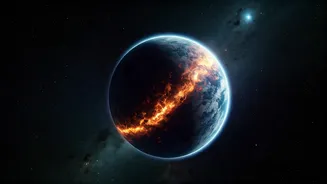
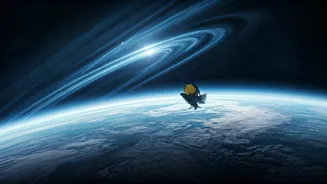
What happens to a solar system after its star dies? The James Webb Space Telescope (JWST) has offered a chilling glimpse into our own potential future by studying a Jupiter-sized planet, WD 1856 b, orbiting a white dwarf—the smoldering remnant of a dead star. This planet is an oddball; it's seven times larger than the tiny, Earth-sized dead star it orbits. It couldn't have formed in its current tight orbit, as it would have been destroyed when its star swelled into a red giant. This implies the planet migrated inwards after its star's violent death, a process scientists are still trying to understand. By studying this 'life after death' system, astronomers are essentially looking at a possible fate for our own solar system billions of years from now, using the universe as a time machine.
The Mystery of the Little Red Dots
When the JWST first powered on, it spotted something unexpected in the cosmic dawn: tiny, bright red dots. Initially thought to be massive, early galaxies that were 'universe breakers' for forming too quickly, the story has become much stranger. As more data has been collected, leading theories have shifted. One prominent idea is that these dots are not galaxies in the traditional sense, but supermassive black holes actively feasting on gas, with their light reddened by vast clouds of dust. An even more exotic theory gaining traction suggests they could be 'black hole stars'—a massive black hole shrouded in a dense, star-like envelope of gas. These objects don't fit neatly into any existing category, challenging our models of how the first large structures in the universe came to be.
An Unknown Signal in Our Backyard
The strangeness isn't limited to the distant universe. Closer to home, recent JWST observations of Pluto and Saturn's moon Titan have revealed a perplexing mystery. Data from both worlds shows a specific wavelength of light is missing from their atmospheric spectra. This 'absorption line' doesn't correspond to any known element or molecule. The implication is that some unknown substance exists in the atmospheres of these two cold worlds—a molecule that has never been seen anywhere else in our solar system or beyond. While scientists are still working to identify this mystery compound, its shared presence on two very different bodies at the edge of the solar system suggests a common, and as yet unexplained, chemical process is at work.