





Understanding Your Destination: The Galactic Core
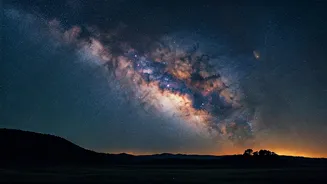
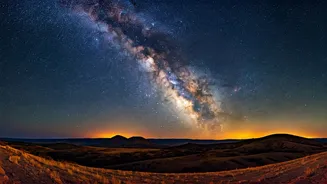
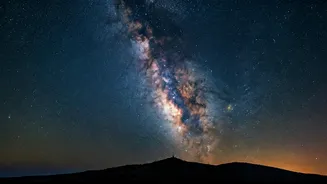
Before you start your search, it helps to know what you’re looking for. The Galactic Core is the rotational centre of the Milky Way, located about 26,000 light-years away in the direction of the constellation Sagittarius. This region is phenomenally dense,
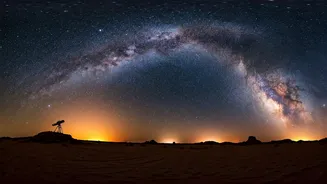
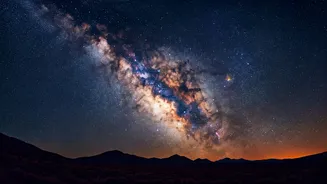
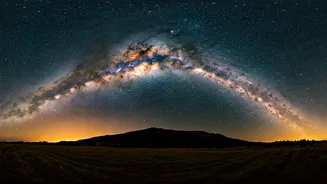
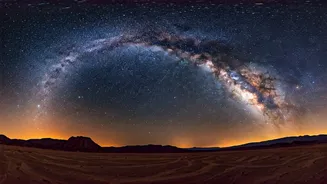
packed with hundreds of thousands of stars, glowing gas clouds, and swirling dust lanes. At its very heart lies Sagittarius A* (pronounced 'A-star'), a supermassive black hole with the mass of four million suns. While you can't see the black hole itself, you can see the brilliant concentration of stars and nebulae that swarm around it, creating the brightest and most dramatic part of the Milky Way band visible from Earth.
The First Rule: Escape the City Lights
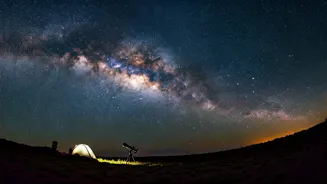
The single most important factor for viewing the Galactic Core is a dark sky. For most of us in India, this means getting away from the light pollution that blankets our cities and towns. The glow from streetlights, buildings, and vehicles washes out faint celestial objects. Your mission is to find a 'dark sky' location. Think remote. High-altitude spots like Ladakh or Spiti are world-class, but less extreme options work too. Consider a trip to the Western Ghats far from Mumbai or Pune, the salt flats of the Rann of Kutch, or designated dark sky parks like the one in Hanle. Even a rural village farm, far from any major highway, will reveal a sky you’ve never seen before.
Timing Your Galactic Expedition
You can’t see the Galactic Core all year round. For observers in India, the prime viewing season runs from April to September. During these months, the core is above the horizon for most of the night. Your second timing factor is the moon. A bright moon acts like a giant, natural light polluter. You must plan your observation around the New Moon, or at least the week leading up to it and a few days after. During this phase, the sky is at its darkest, allowing the faint glow of the distant galaxy to shine through. Check a lunar calendar and plan your trip for a moonless weekend in the summer months.
Your Cosmic Toolkit: From Eyes to Lenses
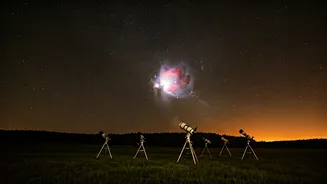
You don't need a professional telescope to begin. In fact, your journey starts with just your eyes. Once you’re in a dark location, give your eyes at least 20 minutes to fully adapt to the darkness. You'll be amazed at what begins to appear. The next step up is a simple pair of binoculars. A standard 7x50 or 10x50 pair will transform the hazy Milky Way into a river of countless individual stars. They are perfect for sweeping the area and spotting bright clusters and nebulae. If you have a basic amateur telescope, you can start resolving even finer details. But binoculars are arguably the best tool for appreciating the sheer scale and richness of this region.
Star-Hopping to the Centre
Now for the 'mapping' part. Finding the core is easier than you think. First, locate the constellation Sagittarius. To observers in the Northern Hemisphere, its brightest stars form a very recognisable shape: a teapot. Look towards the southern sky during summer nights. You’ll see a pattern of stars that looks like a teapot, complete with a handle, lid, and a spout. The steam rising from this celestial teapot’s spout is the densest, brightest part of the Milky Way. You are now looking directly at the Galactic Centre. Pan this area slowly with your binoculars. The star clouds here are so thick they look like luminous smoke. You have successfully navigated to the heart of our galaxy.
Notable Sights Along the Way
While you're exploring the area around the teapot's spout, you'll be sweeping over some of the sky's most famous deep-sky objects. With binoculars, you can easily spot the Lagoon Nebula (M8) and the Trifid Nebula (M20) as small, fuzzy patches of light just above the teapot’s spout. They are stellar nurseries where new stars are being born. Slightly to the east, you might find Ptolemy's Cluster (M7), a brilliant open cluster of stars that looks like a spray of diamonds on dark velvet. Identifying these objects transforms your viewing from simple stargazing into a true tour of our galactic neighbourhood.