


Finding Worlds in the Dark
First, it helps to understand how we find most exoplanets—worlds orbiting stars other than our sun. NASA's TESS, or Transiting Exoplanet Survey Satellite, stares at patches of the sky, watching for tiny, repetitive dips in a star's brightness. These dips,
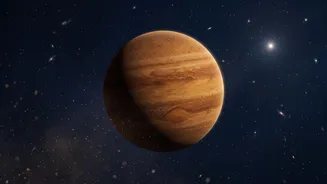
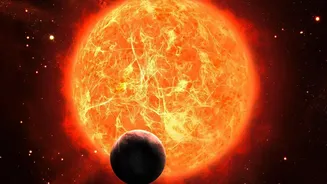
called 'transits', happen when a planet passes in front of its star from our point of view, blocking a minuscule amount of light. Think of it like a moth flying in front of a distant lighthouse beam. By measuring how much the light dims and how often, scientists can calculate a planet's size and its orbital period. TESS has used this method to discover thousands of planet candidates since its launch in 2018. For years, TOI-2535 b, a 'hot Jupiter' about 1,000 light-years away, was one of these regular discoveries. It completed an orbit around its star in just over eight days, appearing right on schedule in TESS's data.
The Case of the Vanishing Planet
Then, things started getting weird. Astronomers noticed that TOI-2535 b's transits were becoming unreliable. Sometimes it would show up as much as six hours early or late. Over time, the dips in starlight also became shorter and fainter. It was as if the planet was slowly fading away. Finally, in early 2026, it stopped showing up in the readings altogether. The scheduled transit came and went, but the starlight from TOI-2535 never dimmed. The planet, for all intents and purposes, had vanished from our view. This wasn't a case of a telescope glitch; it was a genuine astronomical puzzle. Planets don't just disappear into thin air, so scientists knew something extraordinary was happening in that star system.
A Gravitational Tug-of-War
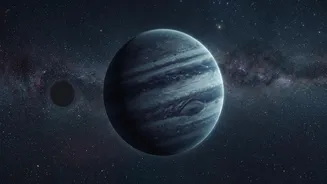
The planet didn't explode or get swallowed by its star. The answer to the mystery lies in gravity. After analyzing all the data, a team of UCLA-led astronomers concluded that TOI-2535 b is not alone. It has an unseen planetary neighbor whose gravitational pull is playing havoc with its orbit. The two planets are locked in a powerful gravitational dance, yanking on each other. This interaction is causing both of their orbits to wobble, like a spinning top that's slightly off-kilter. As Samuel Yee, a postdoctoral fellow at UCLA, explained, this is the most extreme case of two planets interacting so strongly that they have been seen.
A Cosmic Game of Hide-and-Seek
This orbital wobble is tilting TOI-2535 b's path through space. From our vantage point, a transit only happens when a planet's orbit is perfectly aligned to pass between us and its star. Because of the gravitational tug from its neighbor, TOI-2535 b's orbit has tilted just enough that it no longer crosses the face of its star from our perspective. Now, it passes just above or below the star, making it invisible to the transit method. It's the same reason we don't have a solar eclipse every month. The Moon's orbit is slightly tilted relative to Earth's orbit around the Sun, so it only lines up perfectly on rare occasions. In this case, astronomers were lucky enough to watch a planet's alignment change in real-time, over just a few years—a process they thought would take centuries.
What This Tells Us About the Universe
This discovery does more than just solve a single mystery. It provides a rare clue into how 'hot Jupiters'—gas giants orbiting extremely close to their stars—end up where they are. One theory is that they form far away and then migrate inwards after a violent event, like a near-collision, flings them into a new orbit. However, the system of TOI-2535 b suggests a gentler path might be possible, where two planets migrate inward together slowly. The fact that their orbits are tilted suggests there were still some dramatic interactions in the system's past. The 'disappearance' shows that planetary systems are not always the neat, clockwork models we imagine but are often dynamic, evolving, and full of surprises.