

The Fabric of Reality Itself
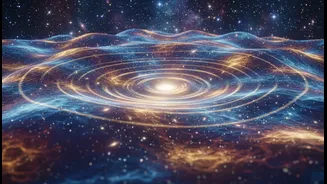
Before we get to the ripples, let's talk about the pond: spacetime. Over a century ago, Albert Einstein gave us a new way to see the universe. He realized that space and time aren't separate things but are woven together into a single, four-dimensional
fabric. Think of it like a giant, stretchy trampoline. Massive objects, like planets and stars, don't just sit in this fabric; they bend it. A star creates a dip, and a planet rolling nearby follows the curve. What we call gravity is just this curvature of spacetime. Your phone’s GPS has to account for this effect, because time literally moves at different speeds depending on how strong gravity is.
Cosmic Car Crashes
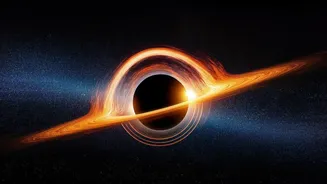
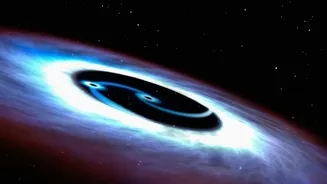
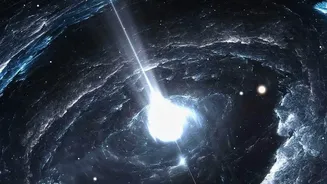
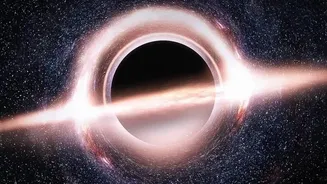
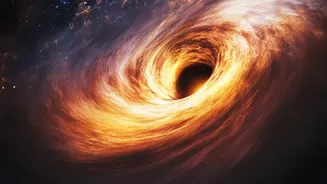
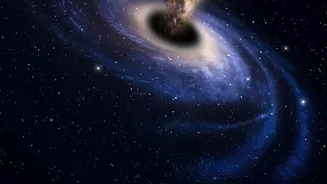
So if spacetime is a fabric, what makes the ripples? The most violent events in the cosmos. When two super-dense objects, like black holes or neutron stars, orbit each other, they churn spacetime. As they spiral closer and closer at incredible speeds, they send out waves of energy—not as light, but as literal ripples in spacetime itself. These are gravitational waves. The final, cataclysmic collision releases an almost unimaginable amount of energy in a fraction of a second, sending a powerful wave across the universe that travels at the speed of light.
Listening to the Universe
By the time these ripples reach Earth, they are impossibly faint. A passing gravitational wave might stretch and squeeze the space you're in by a distance thousands of times smaller than an atom's nucleus. Detecting this required one of the most sensitive machines ever built: the Laser Interferometer Gravitational-wave Observatory (LIGO). In simple terms, LIGO splits a laser beam and sends it down two very long, perpendicular tunnels. The beams bounce off mirrors and recombine. If a gravitational wave passes through, it will minutely stretch one tunnel while squeezing the other, knocking the laser beams out of perfect alignment. This tiny flicker is the 'sound' of a cosmic collision that happened millions or billions of light-years away.
A New Window on the Cosmos
Detecting these waves wasn't just about proving Einstein right again (though it did). It marked the birth of gravitational-wave astronomy. For all of human history, we've studied the universe by looking at light. But many of the most fascinating events, like black holes colliding, are completely dark. Gravitational waves let us 'hear' these events for the first time. It's a completely new sense for exploring the universe. With every new detection, we learn more about black holes, the life and death of stars, and even the expansion rate of the universe itself. The most recent catalog has brought the total number of confirmed detections to nearly 400.
India Joins the Cosmic Quest
This is a global endeavor, and India is a key player. The planned LIGO-India observatory, which broke ground in Maharashtra in April 2026, will be the fifth major detector in the world, joining a network with facilities in the US, Italy, and Japan. Having another 'ear' on the other side of the planet will be transformative. It will allow scientists to pinpoint the source of gravitational waves in the sky with far greater accuracy, helping astronomers quickly point their telescopes to see if there's any light from the event. The Indian observatory, built with state-of-the-art components, will significantly enhance the global network's power to uncover the universe's secrets.