



The Fundamental Challenge: Leaving Mars
Launching a rocket from Earth is a familiar sight, but launching one from another planet is a hurdle humanity has yet to clear. This is the core problem of any Mars return trip. Mars has about 38% of Earth's gravity—less, but still substantial. A rocket needs
to fight that gravity and a thin but present atmosphere to reach orbit. This requires a Mars Ascent Vehicle (MAV), a small, automated rocket that must survive the journey to Mars, endure the harsh Martian environment for months or years, and then execute a perfect launch with no ground crew. The environment itself is a huge obstacle, with temperature swings of over 100°C that can stress materials and electronics. Developing a miniature rocket that can withstand all this and still perform flawlessly is a monumental task.
The Robotic Mission: A Light Packer
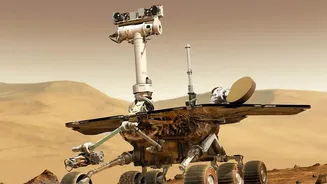
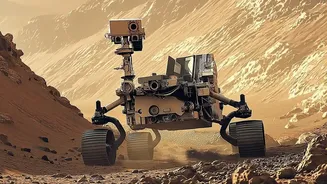
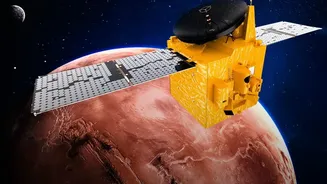
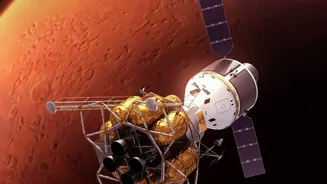
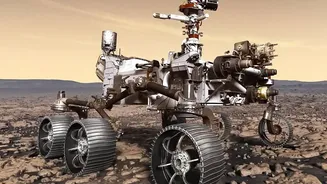
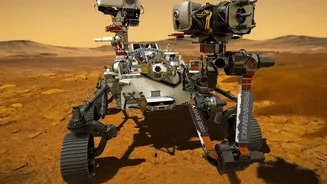
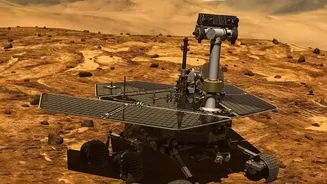
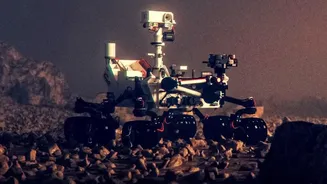
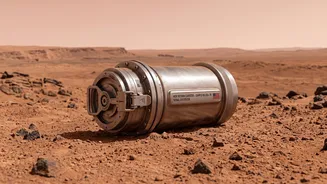
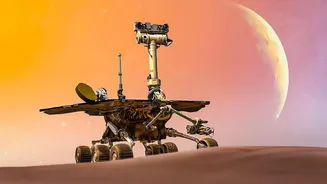
Current robotic plans, like the Mars Sample Return campaign, focus on bringing back small, high-value payloads: rock and soil samples. The Perseverance rover is already collecting and caching these samples. A future lander would deploy a small rover to fetch these samples and load them into the MAV. The MAV for a robotic mission is designed to be as light as possible, carrying a payload of just a few kilograms. It would launch into Mars' orbit, where a larger orbiter, acting as an interplanetary courier, would capture the sample container and fly it back to Earth. The entire process is a complex, multi-stage relay race. While incredibly sophisticated, the engineering is focused on automation, miniaturisation, and surviving the elements without the added burden of keeping anything alive.
The Human Mission: A Whole New Scale
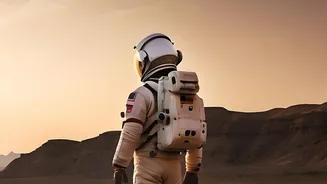
Sending humans changes everything. Instead of a few kilograms of rocks, the return payload includes several astronauts and their habitat. The life support systems alone represent an enormous increase in mass and complexity. For a round trip that could last nearly three years, astronauts require hundreds of metric tons of supplies like food, water, and air if nothing is recycled. This is why developing advanced, reliable life support systems that can recycle air and water is critical. Current systems on the International Space Station are not yet robust enough for a Mars mission. Every kilogram dedicated to keeping humans alive is another kilogram that needs to be launched off Mars, demanding a far larger and more powerful MAV.
The Fuel Problem and a Martian Solution
You can’t just pack all the fuel for a round trip; it would make the initial spacecraft impossibly heavy. The solution is to make the fuel for the return journey on Mars itself, a concept called In-Situ Resource Utilization (ISRU). The Martian atmosphere is about 96% carbon dioxide. Technologies like the Mars Oxygen In-Situ Resource Utilization Experiment (MOXIE) have already proven that oxygen can be extracted from the Martian air. This oxygen can be used for breathing and, crucially, as a rocket propellant oxidizer. Other processes, like the Sabatier reaction, could combine Martian CO2 with hydrogen brought from Earth to create methane (CH4) fuel. By manufacturing propellant on-site, a human mission can dramatically reduce the mass it needs to land on Mars, making a return journey feasible.
Two Different Journeys Home
Ultimately, the return trips for robots and humans are fundamentally different endeavours. A robotic sample return is a marvel of precision engineering, a lightweight, automated system designed to bring back inanimate scientific treasure. It's the essential first step, proving that a launch from another planet is possible. A human return mission, however, is a biological and logistical epic. It requires a heavy-duty, reusable vehicle, a self-sustaining life support bubble, and the ability to manufacture fuel millions of kilometres from home. Robots go on a one-way trip or send back a tiny piece of their destination. Humans, on the other hand, must bring their own portable, sustainable piece of Earth with them and ensure it can get them all the way back.