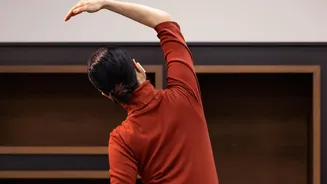







The Problem With a Sedentary Life
Our bodies are designed for movement. Yet, for many of us, long hours spent at a desk, in a car, or on the couch have become the norm. This prolonged sitting forces our bodies into a fixed position that can lead to a cascade of issues. When you sit, your
hip flexor muscles, located at the front of your hips, are held in a shortened, contracted state. Over time, these muscles can become chronically tight. At the same time, your gluteal (buttock) muscles become passive and can weaken from lack of use, a phenomenon sometimes called 'gluteal amnesia'. This combination of tight hip flexors and weak glutes creates a significant imbalance that directly impacts your lower back.
The Critical Hip-Back Connection
Think of your pelvis as a central hub connecting your spine and your legs. Its alignment is crucial for good posture. Chronically tight hip flexors constantly pull the pelvis forward into what’s known as an anterior pelvic tilt. This forward tilt increases the natural curve in your lumbar spine, placing sustained pressure on the vertebrae and spinal discs. To compensate for this imbalance and the lack of support from underactive glutes, the smaller muscles in your lower back are forced to work overtime to keep you upright. This constant strain is what leads to that all-too-common feeling of stiffness, fatigue, and pain in the lower back.
Your Daily Mobility Toolkit
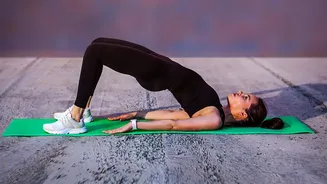
The good news is that you can counteract these effects with a few simple, daily movements. The goal is to lengthen the tight muscles at the front of your hips and activate the dormant muscles in your glutes. Consistency is more important than intensity. Integrating these short exercises into your day can make a world of difference. Kneeling Hip Flexor Stretch: From a kneeling position, step one foot forward so your knee is bent at 90 degrees and your front ankle is under your knee. Keeping your back straight, gently push your hips forward until you feel a stretch in the front of the back leg's hip. Hold for 30 seconds and switch sides. Glute Bridge: Lie on your back with your knees bent, feet flat on the floor hip-width apart, and arms by your sides. Squeeze your glutes and lift your hips off the floor until your body forms a straight line from your shoulders to your knees. Hold for a few seconds at the top before slowly lowering back down. Repeat 10-15 times. 90/90 Stretch: Sit on the floor and position your legs in a '90/90' shape. Your front leg should be bent so the shin is in front of you, with the knee and ankle both at a 90-degree angle. Your back leg should be bent 90 degrees out to the side. Keeping your back straight, gently lean forward over your front shin to feel a stretch in your outer hip. Hold for 30 seconds, then switch sides.
Making Mobility a Habit
Building a new habit doesn't have to be daunting. The key is to find moments in your existing routine to insert these movements. Set a timer to stand up and walk around for a few minutes every hour. While you're waiting for your morning coffee to brew, perform a few standing hip extensions. During a break from your screen, drop to the floor for a set of glute bridges. Even a few minutes of focused movement several times a day is far more effective than one long session once a week. By making these small, consistent efforts, you actively work to reverse the negative effects of sitting and build a more resilient, pain-free back.