


A New Star in the Heavens
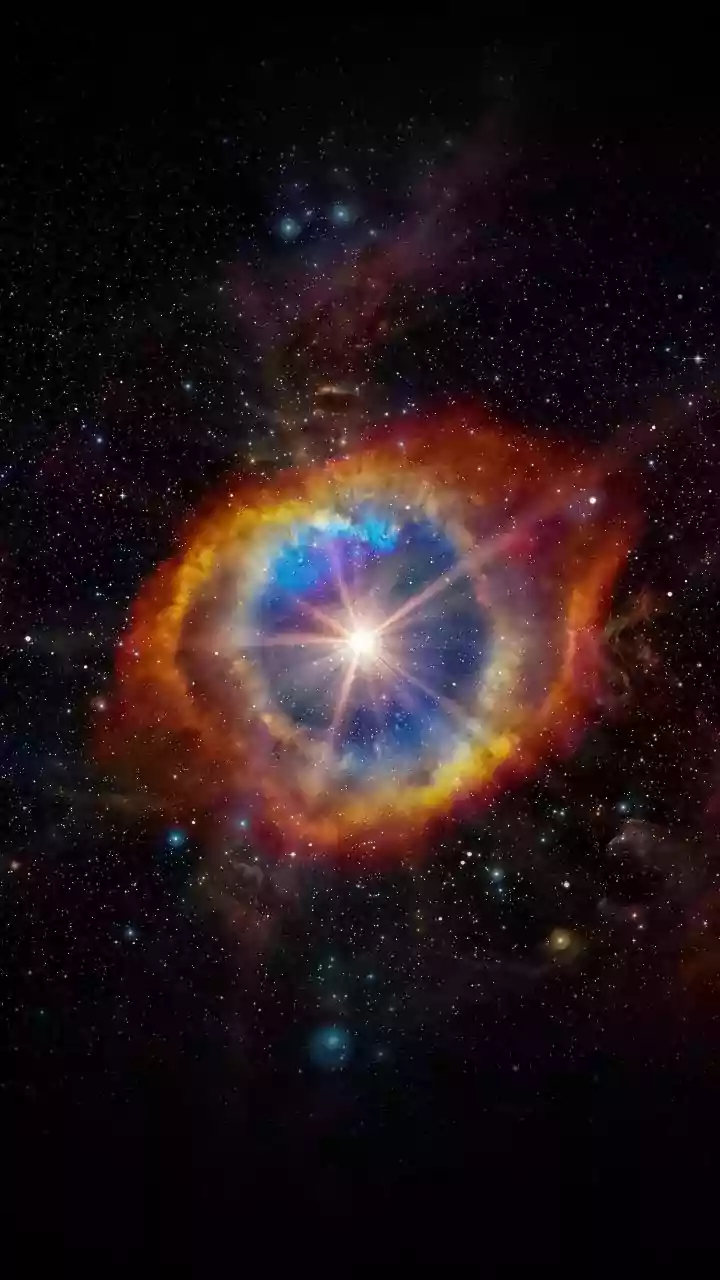
On the evening of October 9, 1604, observers in northern Italy were the first to record a startling sight: a new, intensely bright star in the constellation Ophiuchus, the serpent-bearer. In an era when many celestial events were seen as omens, its appearance
alongside a rare conjunction of Mars, Jupiter, and Saturn caused immense excitement and speculation across Europe and beyond. Within days, the star grew brighter than Jupiter, becoming one of the most luminous objects in the night sky. It remained visible to the naked eye for about a year and a half, even being briefly visible during the daytime, before finally fading from view in early 1606. It was, and remains, the last supernova to be unquestionably observed within our own Milky Way galaxy.
Shattering the Perfect Cosmos
The arrival of this 'stella nova', or new star, posed a profound challenge to the scientific and philosophical beliefs of the time. For centuries, European thought had been dominated by the Aristotelian model of the universe, which held that the heavens beyond the Moon were perfect, eternal, and unchanging. Comets and other transient phenomena were dismissed as atmospheric disturbances in the 'sublunary' sphere. Just 32 years earlier, in 1572, another new star (Tycho's Supernova) had appeared, providing the first major crack in this ancient worldview. Tycho Brahe's careful measurements showed it had no discernible parallax, meaning it must be located far beyond the Moon, among the 'fixed' stars. The appearance of a second new star in 1604 delivered a decisive blow. Two such events in just over three decades could not be ignored; the heavens were not immutable after all.
Enter Johannes Kepler
So why is it called Kepler's Supernova? Johannes Kepler, the Imperial Mathematician in Prague at the time, was not the first to see it. In fact, due to cloudy weather, he didn't get his first look until October 17, more than a week after the initial sightings in Italy. However, what Kepler lacked in timeliness, he made up for with meticulous and sustained observation. Inspired by Tycho Brahe's work on the 1572 event, Kepler tracked the star's position and brightness for over a year, all without the aid of a telescope, which had not yet been turned to the sky. His detailed measurements confirmed that the star had no measurable parallax, proving it belonged to the realm of the stars and not the Earth's atmosphere.
The Book That Cemented a Legacy
Kepler compiled his extensive observations, along with those of other astronomers from across Europe, into a book titled 'De Stella Nova in Pede Serpentarii' ('On the New Star in the Foot of the Serpent-Bearer'), published in 1606. This work became the definitive scientific account of the event. It wasn't just a dry collection of data; Kepler used it to discuss the astronomical, astrological, and cosmological implications of the new star, arguing rationally against superstition while engaging with the questions of his day. While others observed the star, it was Kepler’s comprehensive study and his book that analyzed it in the greatest depth, forever linking his name to the celestial marvel.
A 400-Year-Old Cosmic Mystery Solved
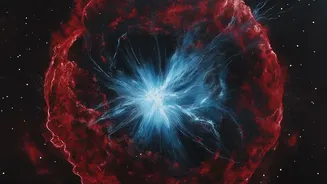
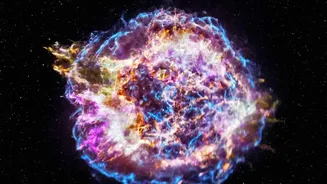
What Kepler and his contemporaries saw was not the birth of a star, but its spectacular death. Modern astronomers have identified the event, officially known as SN 1604, as a Type Ia supernova. This type of explosion occurs in a binary star system where a small, incredibly dense dead star called a white dwarf pulls matter from its larger companion star. When the white dwarf accumulates too much mass, it triggers a runaway thermonuclear explosion that tears it apart. The remnant of this explosion, a faint and expanding shell of gas and dust, was first identified in 1941 and lies roughly 20,000 light-years from Earth. Studying this remnant with modern telescopes like the Chandra X-ray Observatory and the Spitzer Space Telescope continues to give scientists vital clues about the nature of these powerful cosmic events.