


Why Venus? Earth's Hostile Twin
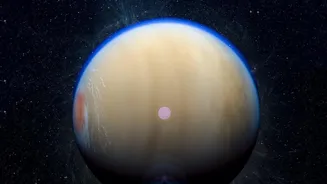
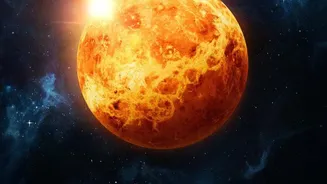
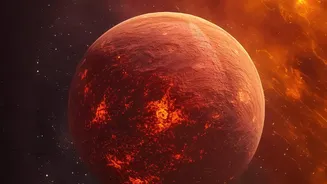
Imagine a planet roughly the same size and mass as Earth, yet with a surface hot enough to melt lead and an atmospheric pressure over 90 times what we experience at sea level. That is Venus. It’s a cautionary tale of a runaway greenhouse effect, a process
scientists are keen to understand for the lessons it may hold for our own planet’s future climate. Its thick atmosphere is dominated by carbon dioxide, with dense clouds of sulfuric acid, completely obscuring the surface. Scientists believe Venus may have once hosted liquid water oceans, similar to early Earth. The critical question is what caused it to transform into the inferno it is today. By studying its extreme environment, ISRO aims to gather vital data on planetary evolution, atmospheric science, and how dramatically a world's climate can change over time. Answering these questions about Venus helps us better understand the conditions that make a planet habitable.
Introducing Shukrayaan: India’s Next Interplanetary Leap
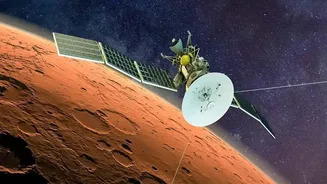
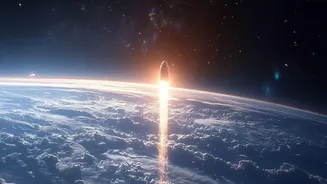
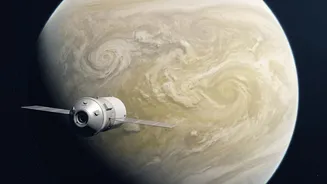
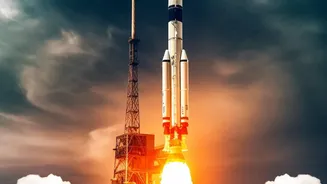
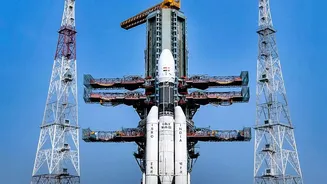
Following the monumental successes of Chandrayaan to the Moon and Mangalyaan to Mars, the Indian Space Research Organisation (ISRO) is setting its sights on Venus. Shukrayaan-1, which translates to 'Venus Craft', is India's first dedicated mission to our planetary neighbour. Formally approved by the government in 2024, the mission is a testament to the nation's growing prowess in space exploration. The launch is currently scheduled for March 2028 aboard the powerful LVM-3 rocket. After a journey of approximately 112 days, the spacecraft is expected to enter a highly elliptical orbit around Venus in July 2028. This orbit, ranging from 500 km at its closest approach to 60,000 km at its farthest, will allow its scientific instruments to study the planet from various altitudes over a planned mission duration of four years. The mission places India in an elite club of space agencies that have ventured to explore one of the most challenging environments in our solar system.
The Eyes of the Orbiter: A Suite of Advanced Sensors
To peer through the dense Venusian clouds and analyze its complex atmosphere, Shukrayaan-1 will be equipped with a payload of approximately 100 kg, comprising around 19 sophisticated instruments. The star of the show is a high-resolution Synthetic Aperture Radar (SAR). Unlike optical cameras, radar can penetrate the thick cloud cover to map the planet's surface in remarkable detail, day or night. This will allow scientists to identify geological features, look for evidence of active volcanoes, and understand the planet's surface processes. Another key instrument is a ground-penetrating radar, which will probe beneath the surface to study its stratigraphy, or rock layers. The mission will also carry a host of other sensors designed specifically to study the 'gas layers' of the atmosphere. These include thermal cameras to map temperature variations and spectrometers to analyze the chemical composition of the air and clouds.
Decoding the Secrets of the Atmosphere
The primary focus of many of Shukrayaan's instruments will be Venus’s notoriously dense atmosphere. The mission aims to understand its structure, composition, and super-rotating dynamics—where the atmosphere circles the planet faster than the planet itself rotates. With international collaboration, the orbiter will carry instruments like the Venus InfraRed Atmospheric Gases Linker (VIRAL), contributed by Russia, to study the composition of atmospheric gases with high precision. Another collaborative payload, the Venusian Neutrals Analyzer (VNA) from Sweden, will study how the solar wind—a stream of charged particles from the Sun—interacts with the upper atmosphere and strips away atmospheric particles over time. This process is crucial for understanding how Venus may have lost its water and evolved into its current state. By studying these interactions and the different gas layers, ISRO hopes to piece together a comprehensive picture of the Venusian climate system.