



The Sun’s Hidden Danger
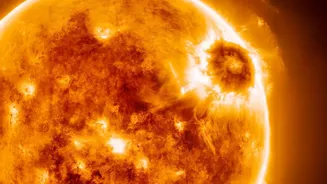
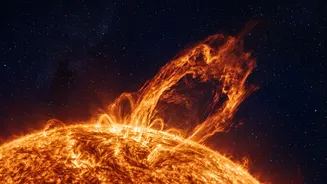
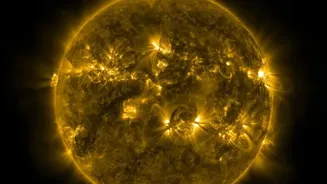
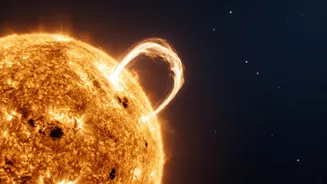
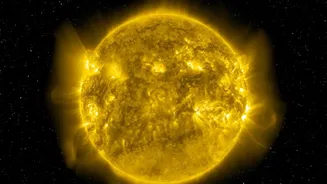
Our civilisation is wrapped in a digital blanket, one that is highly vulnerable to the sun's dramatic mood swings. Solar flares, immense explosions on the sun's surface, can unleash torrents of energy that travel at the speed of light. These are often
followed by coronal mass ejections (CMEs), which are vast clouds of magnetised particles that can take days to reach Earth. When a powerful CME strikes our planet's magnetic field, it can induce a geomagnetic storm. The effects are not abstract; these storms can generate currents that overload power grids, potentially causing widespread blackouts. They can also disrupt GPS signals, damage satellite electronics, and sever radio communications, impacting everything from air travel to financial transactions. The most extreme example on record is the 1859 Carrington Event, which set telegraph stations on fire. A storm of that magnitude today could cripple global infrastructure for months or even years.
A Cosmic Guessing Game
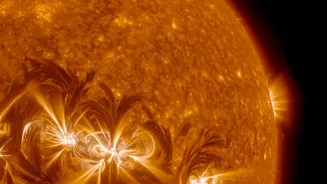
Predicting which solar active region will erupt, and when, has historically been a challenge for space weather forecasters. For years, scientists have relied on observing the sun's surface and looking for complex, tangled magnetic fields in sunspot regions that are prone to unleashing flares. However, these methods often provide limited advance warning, sometimes only minutes before a flare's most intense energy reaches us. While this is better than nothing, it offers a very small window for authorities and companies to take protective measures. This reactive approach leaves our most critical systems exposed, as operators scramble to respond to an event that is already underway. The goal has always been to move from merely observing space weather to accurately forecasting it with enough lead time to make a difference.
Enter the DAGGER Model
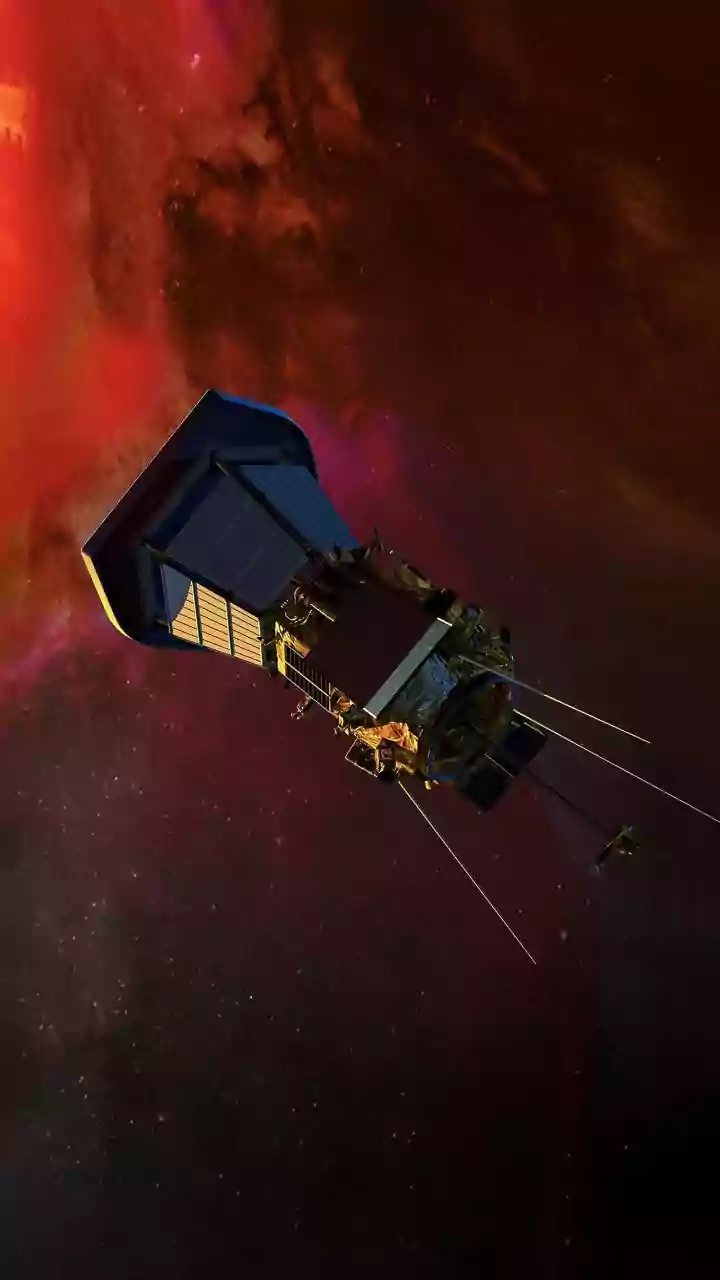
A new tool developed by an international team of researchers may be the breakthrough forecasters have been waiting for. The project, a public-private partnership including NASA and other US agencies, has produced an AI model called DAGGER (Deep Learning Geomagnetic Perturbation). This is not just another incremental improvement. DAGGER uses deep learning—a type of artificial intelligence—to analyse real-time data from a fleet of NASA satellites that constantly monitor the solar wind, the stream of particles flowing from the sun. By training the AI on vast archives of data from past solar storms and their corresponding impacts on Earth, the system has learned to identify the subtle precursor patterns that are invisible to human analysts.
A Critical 30-Minute Warning
The key advantage of the DAGGER model is its speed and precision. It can analyse the incoming solar wind data and predict where a geomagnetic disturbance will strike, anywhere on Earth, with about 30 minutes of advance warning. This 30-minute window is transformative. It's the crucial time difference between the arrival of a flare's light (which travels at the speed of light) and the slower-moving particles of a CME. It is enough time for power grid operators to reroute power and protect sensitive transformers. Satellite controllers can place their spacecraft into a protective safe mode, and airlines can redirect polar flights to avoid communication blackouts and heightened radiation exposure for passengers and crew. The model runs its calculations in less than a second and provides updates every minute, offering a dynamic, global view of the threat.
What This Means for India
The implications of this technology are global, with particular relevance for a digitally advancing nation like India. With the rapid expansion of digital payments, a burgeoning space program featuring assets like the NavIC satellite navigation system, and an economy increasingly reliant on stable connectivity, India's infrastructure is more exposed to space weather than ever before. Better forecasting provides a shield for these vital national assets. The lead author of the paper on the DAGGER model, Vishal Upendran, is from the Inter-University Center for Astronomy and Astrophysics in India, highlighting the global and collaborative nature of this crucial research. The open-source nature of the DAGGER code also means that Indian grid operators and telecommunications companies could one day adopt and tailor the system to their specific needs, enhancing national resilience.