






The Ringed Jewel: Saturn
While the peak of the Perseids has passed, late August offers a fantastic opportunity to view Saturn. The ringed planet will be visible for most of the night, rising in the east around sunset and making its way across the sky. Although its official opposition—when
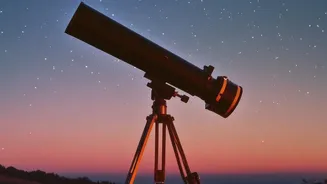
Earth passes directly between Saturn and the Sun—is not until early October, August is when it becomes brilliantly placed for evening observation. During this period, it will be one of the brightest objects in the night sky, appearing as a steady, golden point of light. Even a modest pair of binoculars can stabilize its glow, but a small telescope will begin to reveal its most famous feature: its magnificent rings. In 2026, the rings are tilted at a narrow angle towards us, offering a unique, slender view compared to other years.
The Morning Planets: Mars and Venus
For the early risers, the pre-dawn sky holds its own rewards. Mars will be visible high in the sky before sunrise, a distinctly reddish point of light. The Red Planet rises after midnight and remains a prominent fixture until dawn. Meanwhile, Venus will be shining brilliantly as the 'Evening Star' just after sunset. It will be unmistakably bright in the western sky as dusk settles. If you are up before sunrise around mid-August, you might also catch Mercury low on the eastern horizon, though it can be a challenging spot against the approaching dawn.
The Heart of the Milky Way
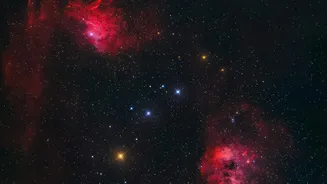
August is one of the best months to witness the core of our own galaxy, the Milky Way. The main challenge across much of India is the monsoon cloud cover, but clear nights, especially after a spell of rain, can offer exceptionally transparent skies. To find it, look towards the south for the constellations Scorpius and Sagittarius. Scorpius is easily identified by its scorpion-like shape and the bright red star Antares, which marks its heart. Just to the east of Scorpius is Sagittarius, often imagined as a teapot. The spout of this celestial teapot points directly towards the galactic centre, the densest and brightest part of the Milky Way. From a dark location, away from city lights, this area appears as a luminous, hazy band of light stretching across the sky.
The Summer Triangle and Other Stars
High overhead in the August sky is a prominent asterism known as the Summer Triangle. It’s not a constellation itself, but an easily recognizable shape formed by three of the brightest stars in the sky: Vega in the constellation Lyra, Deneb in Cygnus (the Swan), and Altair in Aquila (the Eagle). This celestial landmark is so bright that it can be spotted even from light-polluted urban areas. Once you locate the triangle, you can use it as a guide to explore the surrounding constellations. The band of the Milky Way runs right through the Summer Triangle, with Cygnus nestled within it. In the northern sky, look for the familiar ‘W’ shape of Cassiopeia.
Tips for the Best Viewing Experience
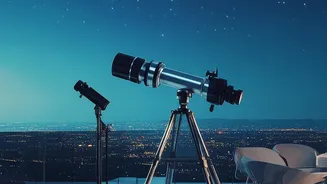
To make the most of your stargazing session, a few simple steps can make a huge difference. First, find a location away from the glare of city lights. Light pollution washes out fainter stars and the subtle glow of the Milky Way. Regions like Ladakh, Spiti Valley, and the Rann of Kutch are famously dark, but even a park or a rural area outside your city will improve your view. Second, give your eyes time to adapt. It takes about 20 to 30 minutes for your pupils to fully dilate and adjust to the darkness, revealing many more stars than are initially visible. Finally, while many of these sights are visible to the naked eye, a good pair of binoculars can dramatically enhance your view, revealing star clusters and the sheer density of stars in the Milky Way.