

New Eyes on an Ancient Universe
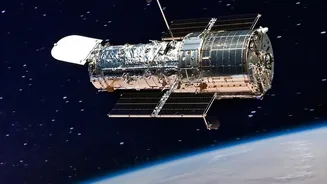
The game-changer in this new era of cosmic discovery is the James Webb Space Telescope (JWST). Launched in late 2021, it orbits the sun a million miles from Earth, far beyond our atmosphere's distorting haze. Unlike its predecessor, the Hubble Space Telescope,
which primarily sees visible light, JWST is designed to see the universe in infrared. This is crucial because the light from the most distant galaxies has been traveling for over 13 billion years. As the universe expands, this light gets stretched into longer, redder wavelengths, eventually becoming infrared. By detecting this faint, ancient light, JWST effectively acts as a time machine, giving astronomers an unprecedented view of the cosmos as it existed in its infancy.
Piercing the Cosmic Dust
One of the biggest challenges in observing galaxies, especially young ones, is cosmic dust. Huge clouds of dust and gas are the nurseries where stars are born, but they also act like a thick fog, obscuring what’s happening inside. Infrared light, with its longer wavelength, can penetrate this dust in a way visible light cannot. This has allowed JWST to reveal the processes of star and galaxy formation in stunning detail. Recent studies have looked at galaxies from when the universe was less than two billion years old. While some were already “dead” with little star formation, others showed intense activity hidden behind a dusty veil. This shows that the process of galaxies shutting down their star-making factories was more complex and varied than previously thought.
The Puzzle of 'Impossible' Early Galaxies
One of the most startling discoveries from JWST is the existence of galaxies in the early universe that appear too massive, too bright, and too mature. Astronomers are finding galaxies that seem to have built up billions of suns' worth of mass when the universe was only a few hundred million years old. These observations challenge existing models, which predicted a more gradual process of galaxy formation. Some of these objects, nicknamed "Little Red Dots," are thought to be the bright cores of primordial galaxies, possibly powered by supermassive black holes that formed surprisingly early. These findings don't break our understanding of cosmology, but they do indicate that the early universe was far more efficient at creating complex structures than we ever imagined.
Galaxy Building in Action
Beyond just seeing these early galaxies, scientists are now able to watch them grow. In a recent discovery, astronomers identified the most distant example of a "nuclear disc"—a dense, rotating disc of new stars at the very heart of a galaxy seen as it was over nine billion years ago. This structure appears to have been formed by a large, bar-shaped collection of stars that funnelled gas and material toward the galactic centre. Such bars are common in modern galaxies like our own Milky Way, but finding one so actively shaping a galaxy much earlier in cosmic history shows that galaxies were developing complex internal structures sooner than assumed. This suggests that galaxies matured rapidly, following similar evolutionary paths across billions of years.
Why These Distant Secrets Matter
Studying the birth and growth of the universe's first galaxies is about more than just collecting cosmic trivia. It’s a form of galactic archaeology that helps us piece together our own origin story. By understanding how other galaxies formed, how they built up heavy elements, and how their central black holes grew, we gain crucial insights into the formation of our own Milky Way. The processes that governed these distant, ancient systems are the same ones that eventually led to the creation of our sun, our planet, and the chemical elements necessary for life. Every secret uncovered from the dawn of time is another piece of the puzzle of our own existence.