

A Galaxy of Extreme Weather
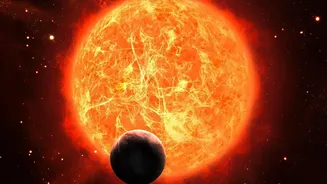
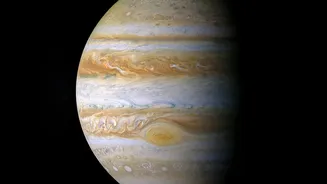
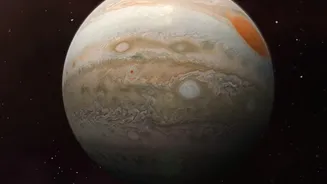
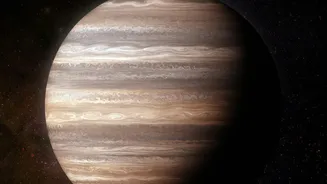
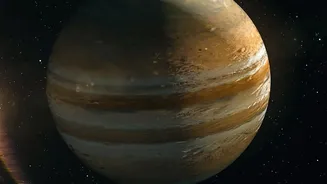
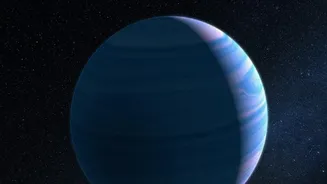
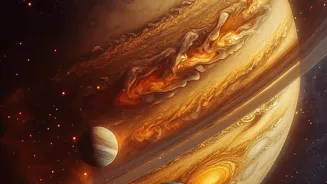
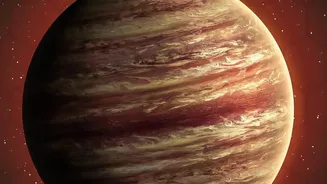
Imagine a world where the winds move faster than the speed of sound and the rain isn't water, but liquid metal. This isn't science fiction; it's the reality on exoplanets known as 'hot Jupiters'. These are gas giants, similar in size to our own Jupiter,
but orbiting incredibly close to their parent stars. One of the most studied examples is WASP-76b, a planet located about 640 light-years away. Its day side temperatures can soar above 2,400 degrees Celsius, hot enough to vaporize metals like iron. Powerful winds, sometimes reaching speeds of over 33,000 km/h, then whip these metallic vapors around the planet. These findings, which once seemed purely theoretical, are now being observed in stunning detail, painting a picture of weather systems far more violent and exotic than anything in our solar system.
The Technology That Sees a Storm
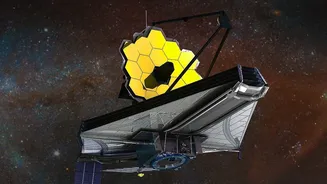
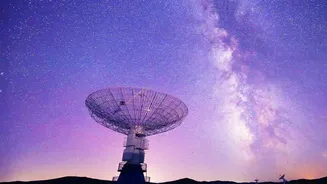
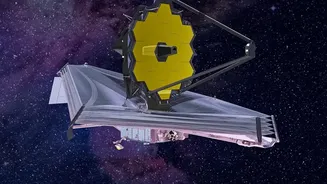
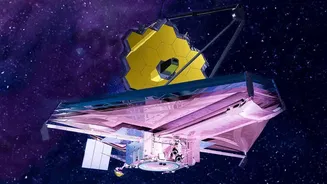
So, how can astronomers possibly see the weather on a planet hundreds of light-years away? The answer lies in the power of modern infrared telescopes, like the James Webb Space Telescope (JWST) and the European Southern Observatory's Very Large Telescope (VLT). The key technique is called spectroscopy. When an exoplanet passes in front of its star from our point of view, a tiny amount of starlight filters through the planet's atmosphere. Telescopes capture this light and split it into a spectrum, like a rainbow. Different elements and molecules in the atmosphere absorb light at very specific wavelengths, leaving behind dark lines in the spectrum. These lines act like a chemical fingerprint, allowing scientists to identify exactly what's in the planet's air—from water vapour to, incredibly, vaporized iron.
It Rains Iron on the Night Side
The phenomenon of 'iron rain' on planets like WASP-76b is a direct result of their extreme conditions. These planets are often 'tidally locked', meaning one side permanently faces the star (the dayside) while the other faces the cold of space (the nightside). On the scorching dayside, the intense heat turns iron into a gas. Then, powerful, supersonic winds carry this iron vapour across the planet to the cooler nightside. There, the temperature drops enough—though it's still incredibly hot by Earth standards—for the iron to condense from gas into liquid droplets, forming clouds of molten metal that then rain down. Scientists confirmed this by detecting the chemical signature of iron vapour on the dayside, but not on the nightside, inferring that the iron had condensed and rained out of the atmosphere.
Winds Faster Than a Fighter Jet
The wind speeds on these hot Jupiters are almost incomprehensible. On a planet named WASP-127b, astronomers have measured an equatorial jet stream howling at nearly 33,000 km/h. To put that in perspective, that's more than 25 times the speed of sound on Earth and drastically faster than the fastest winds ever recorded on Neptune, which top out around 1,800 km/h. Scientists measure these speeds using the Doppler effect. As the planet rotates, the winds on the side moving towards us cause the light's wavelength to slightly compress (a 'blueshift'), while winds on the side moving away cause it to stretch (a 'redshift'). By measuring this tiny shift in the spectral lines of elements in the atmosphere, astronomers can calculate the wind's velocity with astonishing precision.
Why Study These Hellish Worlds?
While planets with iron rain are unlikely to host life, studying them is crucial for understanding how planets form and evolve. These extreme worlds serve as natural laboratories, allowing scientists to test their models of atmospheric physics under conditions that don't exist in our solar system. Understanding the dynamics of a hot Jupiter's atmosphere—how heat is transported, how clouds form, and how winds behave—helps refine the fundamental principles of planetary science. This knowledge, in turn, helps us understand the vast diversity of planets in our galaxy and provides a crucial baseline for the search for more temperate, Earth-like worlds. Each discovery made with tools like the JWST brings us one step closer to answering the ultimate question: are we alone?