
1. What Exactly Did Hubble Find?
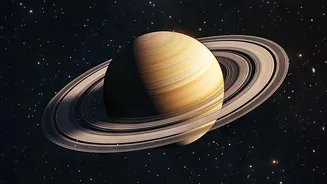
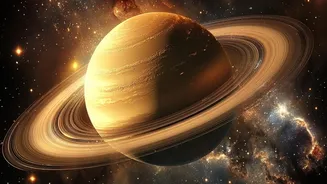
In early September 2026, NASA and the European Space Agency announced a remarkable discovery made by the Hubble Space Telescope: a massive, 10-sided atmospheric wave encircling Saturn's south pole. Dubbed the 'decagon', this is the first time a large,
regular-sided jet stream pattern has been observed in the planet's southern hemisphere. Unlike a solid structure, this feature is a wave within the planet's powerful jet streams, extending deep into multiple layers of the atmosphere. Scientists are especially excited because the feature appears to be evolving. By reviewing years of Hubble data from the Outer Planet Atmospheres Legacy (OPAL) program, they found faint hints of the structure emerging as far back as 2023 before it sharpened into a clear 10-sided pattern more recently.
2. How Does It Compare to Saturn’s Famous Hexagon?
For over 40 years, scientists have been captivated by a six-sided jet stream at Saturn’s north pole, known as the hexagon. That feature is incredibly stable, persisting since it was first spotted by the Voyager spacecraft in the early 1980s. The new decagon provides a fascinating southern counterpart. While both are colossal geometric patterns formed by atmospheric waves, there are key differences. The most obvious is the number of sides—ten versus six. The decagon also appears to be a much newer phenomenon. Its recent and rapid development suggests scientists are getting a rare chance to watch a giant planetary weather pattern being born, whereas the hexagon has been a long-established fixture. The discovery confirms that the northern hexagon isn't as unique as once believed.
3. Why Did This Discovery Happen Now?
The timing of the discovery is a combination of planetary mechanics and dedicated observation. For years, the south pole of Saturn was tilted away from Earth, hiding it from view. As Saturn's long seasons changed, the southern hemisphere gradually came back into view, allowing Hubble to get a clear look. According to lead author Agustin Sánchez-Lavega, scientists had been searching for a southern counterpart to the hexagon since 1990 without success. Even NASA's Cassini spacecraft, which orbited Saturn from 2004 to 2017, saw no hint of a long-lived decagon. The feature seems to have formed very recently, which has stunned the scientific community. “The most intriguing part to me is that this seems to have just formed recently,” said Amy Simon, a study co-author from NASA. “The question is, why did it suddenly form now when we haven't seen one before?”
4. How Do These Strange Shapes Even Form?
While they look unnatural, these geometric shapes are the result of fluid dynamics on a planetary scale. Saturn's atmosphere has powerful jet streams—currents of gas moving at tremendous speeds. The polygonal patterns are believed to be a type of 'meandering wave' within these jets. Think of a fast-flowing river; small disturbances can create stable, repeating wave patterns. On Saturn, small agitations in the jet stream, perhaps from jostling with other air currents, can cause it to meander into a stable polygonal shape that rotates with the planet. Scientists have even replicated the formation of hexagons and other polygons in laboratory experiments by rotating circular tanks of liquid at different speeds, which causes similar patterns to emerge in the turbulent flow between the fluid bodies.
5. What Happens Next?
The discovery of the decagon opens a new frontier for planetary scientists. A key question is whether it will be a long-lived feature, like the northern hexagon, or if it is a transient phenomenon that will eventually dissipate. Researchers will continue using the Hubble Space Telescope, and likely the James Webb Space Telescope, to monitor the decagon's evolution. Observing how it behaves—whether it strengthens, weakens, or changes shape—will provide invaluable data on the atmospheric dynamics of gas giants. Understanding what drives the formation of these giant waves can help scientists refine their models of planetary weather, offering insights not just into Saturn's atmosphere, but also those of Jupiter, Uranus, Neptune, and potentially even planets beyond our solar system.