




A Cosmic Crime Scene
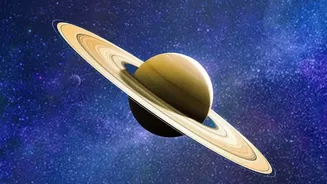
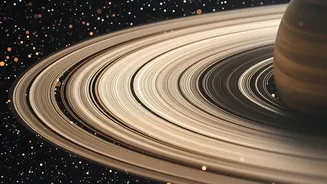
For much of astronomical history, Saturn's rings were thought to be primordial, having formed 4.5 billion years ago along with the gas giant. It made sense; they seemed like a permanent, majestic fixture. However, data gathered by NASA's Cassini spacecraft,
which orbited Saturn for 13 years, turned this long-held assumption on its head. The evidence pointed to a much younger age—perhaps only 100 to 400 million years old. This means the rings may have formed when dinosaurs still roamed the Earth and were not a feature of Saturn for most of its existence. The clues came from two key properties: the rings' mass and their brightness. They are composed of about 98% pure water ice, with particles ranging from tiny dust grains to mountain-sized chunks. Over billions of years, these pristine ice particles should have been darkened and polluted by a constant bombardment of micrometeoroids, becoming a sooty grey. Their surprising brightness today suggests they simply haven't been around long enough to accumulate that much cosmic dust.
The Birth of the Rings
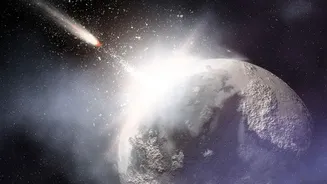
If the rings are young, how did they form? The leading theory is that they are the remnants of a catastrophic event. One hypothesis suggests an icy moon of Saturn, perhaps the size of its third-largest moon Iapetus, strayed too close to the planet. Once it crossed a boundary known as the Roche limit, Saturn's immense gravitational pull would have been stronger than the moon's own gravity holding it together, tearing it apart into billions of icy shards that then spread out to form the rings. One study even gave this hypothetical destroyed moon a name: Chrysalis. Another variation on this theory is that the moon didn't just wander too close but was shattered by a collision with a large comet or asteroid. Whatever the exact cause, the evidence points to a dramatic and relatively recent celestial demolition that gave birth to the spectacular feature we see today.
A Disappearing Act in Slow Motion
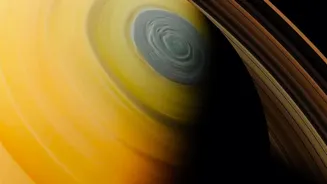
Just as we've learned the rings are a new addition, we've also discovered they are temporary. The same Cassini mission that helped determine their age also confirmed they are actively disappearing. This process is known as 'ring rain'. Particles from the innermost rings are being pulled inward by Saturn's gravity and magnetic field, falling into the planet's upper atmosphere. This isn't just a gentle drizzle; Cassini's instruments measured a torrential downpour, with as much as 10,000 kilograms of ring material—mostly water ice, but also complex organic molecules like butane and propane—raining down on Saturn every second. This constant loss of material is stripping the rings of their mass. The inflow is so significant that it actually changes the chemistry and temperature of parts of Saturn's atmosphere where it falls.
The Final Curtain Call
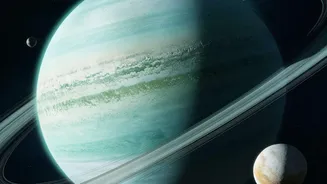
At the current rate of decay, scientists estimate that Saturn's rings will be completely gone in a relatively short astronomical timeframe. Predictions vary, but the consensus suggests they have between 100 million and 300 million years left. While that sounds like an eternity to us, it's a fleeting moment in the 4.5-billion-year life of the solar system. This means humanity is incredibly lucky to exist at a time when Saturn is at its most glorious. The faint, wispy rings we see around other gas giants like Jupiter and Uranus might be the remnants of what were once grand ring systems like Saturn's, offering a glimpse into Saturn's distant future. The disappearance isn't something anyone alive will witness—though there will be a temporary 'disappearance' in 2025 when the rings are tilted edge-on to Earth, making them invisible to most telescopes before they tilt back into view.