
The Sun's Volatile Temperament
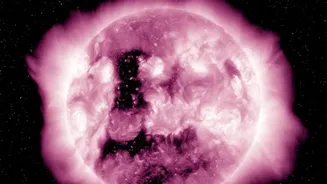
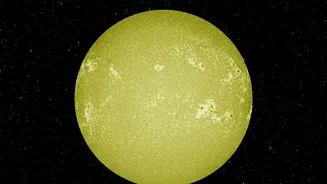
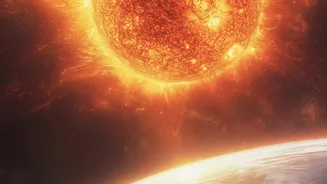
Space weather refers to the changing conditions in space, driven primarily by the Sun. Our star periodically ejects massive bursts of energy and particles in events known as solar flares and coronal mass ejections (CMEs). A solar flare is an intense eruption
of radiation, which travels at the speed of light and can reach Earth in about eight minutes. CMEs are larger, slower explosions of magnetised plasma that can take one to three days to travel the 150 million kilometres to our planet. When these storms are aimed at Earth, they interact with our planet's magnetic field and can cause significant disruptions to technology both in space and on the ground.
Satellites in the Firing Line
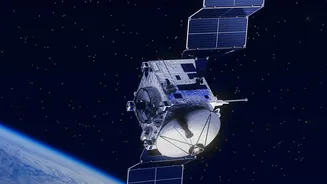
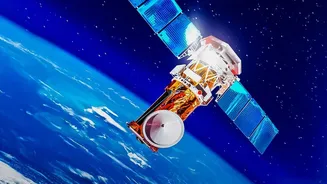
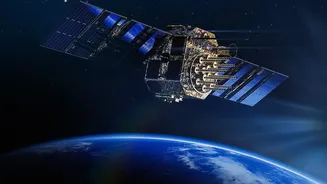
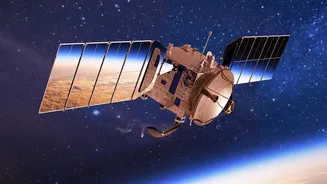
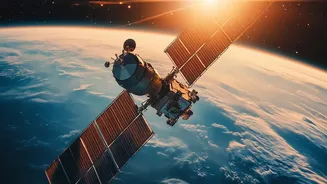
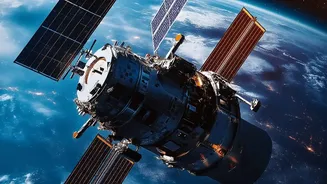
Satellites are particularly vulnerable to space weather. For those in Low Earth Orbit (LEO), a major threat is increased atmospheric drag. During a geomagnetic storm, the Earth's upper atmosphere heats up and expands, becoming denser. This increased density acts like a brake on satellites, causing them to lose altitude. In a dramatic example from February 2022, a minor geomagnetic storm increased atmospheric drag enough to cause the loss of up to 40 new Starlink satellites, which burned up as they were unable to reach their operational orbit. High-energy particles from solar events can also damage sensitive electronics, degrade solar panels, and cause phantom commands that disrupt a satellite's function. Furthermore, this activity can distort the very GPS signals satellites transmit, leading to inaccuracies for navigation systems on Earth.
Our Global Eyes on the Sun
To guard against these threats, a global network of space and ground-based observatories constantly monitors the Sun. A key player is the U.S. National Oceanic and Atmospheric Administration's (NOAA) Space Weather Prediction Center (SWPC), which serves as an official source for alerts. These agencies use data from a fleet of satellites, such as the GOES and DSCOVR spacecraft. Satellites positioned at a special gravitational balance point 1.5 million kilometres from Earth, called Lagrange Point 1 (L1), act as an early-warning system. They can detect the solar wind and CMEs about 15 to 60 minutes before they reach our planet, providing crucial lead time.
India's Aditya-L1 Joins the Watch
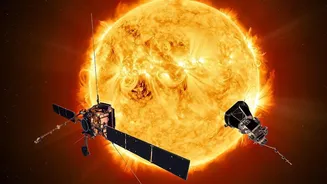
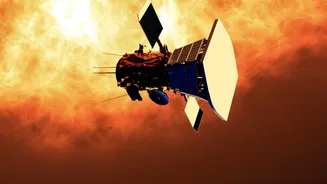
India has significantly bolstered its space weather monitoring capabilities with the Aditya-L1 mission. Launched by the Indian Space Research Organisation (ISRO) in September 2023, Aditya-L1 is also positioned at the L1 point. Its suite of seven instruments provides a continuous view of the Sun, observing solar flares, CMEs, and the solar wind. Data from Aditya-L1 is designed to improve our understanding of the Sun's dynamics and contribute vital information for more accurate space weather forecasts. This not only protects India's own growing fleet of satellites but also contributes to the global effort to safeguard space-based assets. Early findings from the mission have already provided breakthrough insights into the structure of solar storms and their impact on Earth's magnetic shield.
From Warning to Action
When monitoring networks detect a threatening solar event, they issue watches, warnings, and alerts to satellite operators, airlines, and power grid managers. This advanced notice allows satellite operators to take protective measures. They might switch a satellite to a protective "safe mode" to shield its electronics, postpone sensitive manoeuvres, or even use onboard thrusters to slightly raise the satellite's orbit to counteract increased atmospheric drag. For airlines, these forecasts can inform decisions to reroute flights to avoid communication disruptions and higher radiation levels at high altitudes. It is this continuous cycle of observation, prediction, and action that forms our primary defence against the Sun's volatile nature.