
Earth's Frozen Time Capsules
Imagine a place so consistently cold that every year's snowfall is preserved, layered on top of the last for millennia. In the polar regions, this is exactly what happens. As new snow falls, its weight compresses the older layers beneath it, slowly transforming
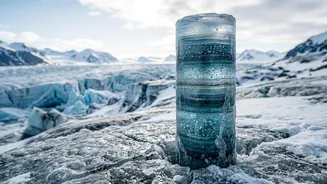
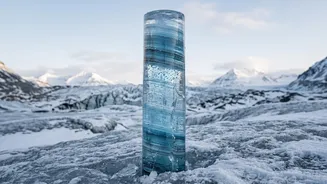
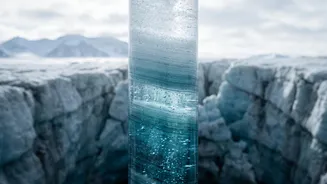
them into dense glacial ice. This process traps not just the frozen water, but also a snapshot of the atmosphere from that specific time. Each layer acts like a tree ring, a page in a diary that scientists can read to understand what Earth’s climate was like hundreds of thousands of years ago. The longest continuous records stretch back 123,000 years in Greenland and an astonishing 800,000 years in Antarctica.
Drilling Deep for Ancient Secrets
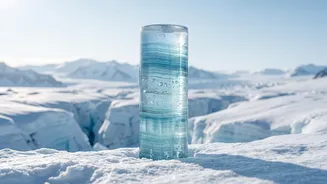
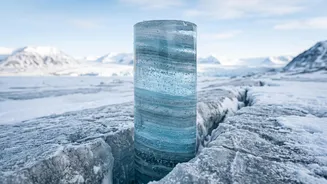
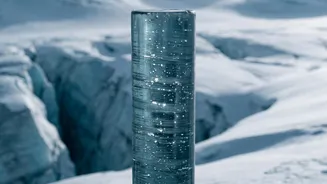
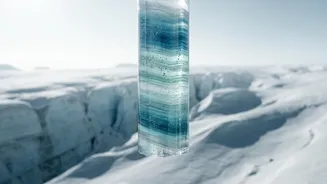
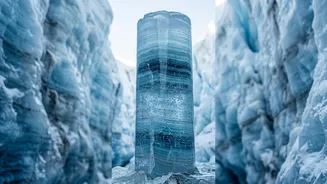
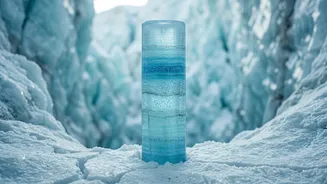
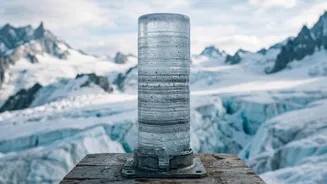
Retrieving this archive is a monumental task. Scientists establish camps in some of the world's most inhospitable environments to conduct drilling operations. Using specialised electromechanical drills, they bore down, sometimes for several kilometres, into the ice sheet. The drill is designed to cut a cylindrical column of ice, typically a few metres long per run, which is then carefully brought to the surface. The process is slow and meticulous, often requiring multiple summer field seasons to reach the desired depth. As the drill goes deeper, a special fluid is used to keep the borehole from collapsing under the immense pressure of the surrounding ice. Each core section is catalogued and preserved in a frozen state for its long journey to laboratories around the world.
Reading the Bubbles and Dust
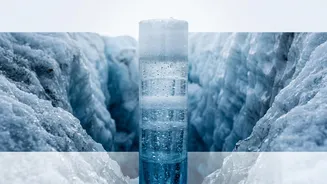
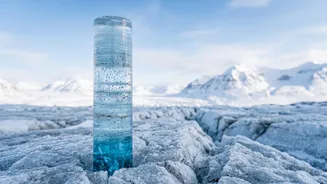
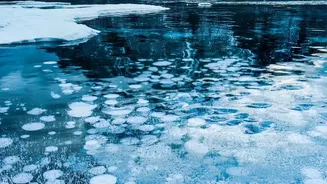
Once in the lab, the ice cores are carefully analysed. One of the most critical components are the tiny air bubbles trapped within the ice. These bubbles are pristine samples of past atmospheres. By crushing the ice in a vacuum, scientists can measure the concentration of greenhouse gases like carbon dioxide and methane from long before human records began. Beyond the bubbles, the ice itself tells a story. The chemical makeup of the water, specifically the ratio of different types of oxygen and hydrogen atoms (isotopes), can reveal the temperature when the snow first fell. Furthermore, trapped particles like volcanic ash, sea salt, and desert dust give clues about major geological events, wind patterns, and the extent of sea ice in the past.
A Story of Fire, Ice, and Air
The data from ice cores has been revolutionary for climate science. It provided the first direct proof that atmospheric carbon dioxide and global temperatures have been tightly linked for at least the last 800,000 years. These frozen archives show that for millennia, CO2 levels naturally fluctuated between about 180 and 300 parts per million. The records also reveal abrupt climate shifts in the past, where regional temperatures changed dramatically over just a few decades. This historical context makes our current situation all the more stark. Ice core data clearly shows that CO2 concentrations began to rise with the industrial revolution and are now nearly 40% higher than at any point in the last 800,000 years.