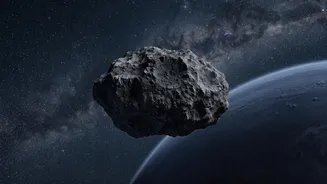




For a few weeks, the identity of a faint object looping around our planet was a genuine mystery. Was it a lost piece of a rocket or something else entirely? Now, scientists have an answer for Earth's newest, temporary cosmic companion.
A Mysterious Visitor Appears
In August 2026,
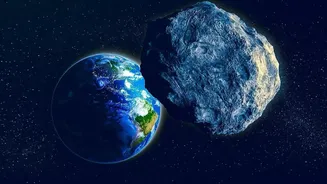
Hungarian astronomer Krisztián Sárneczky spotted a faint, previously unknown object moving through the sky. Initially designated Sar2901, it seemed like just another one of the hundreds of near-Earth asteroids he had discovered. However, as astronomers tracked its path, they realised something was unusual. Precise orbital calculations showed that this object wasn't just passing by; it was actually orbiting the Earth. This led to a critical question that needed answering: was this a natural asteroid that had been captured by Earth's gravity, or was it a piece of human-made space debris, like a spent rocket booster or a defunct satellite, returning to haunt us? The astronomical community was split, and the detective work began.
The Hunt for Cosmic Clues
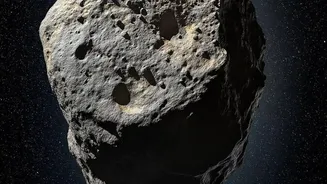
Confirming the object's identity was a challenge. Now officially named 2026 QQ8 by the International Astronomical Union's Minor Planet Center, it is incredibly small, estimated to be only about one to two metres in diameter — roughly the size of a large appliance. Its small size and faintness made it difficult to analyse. To solve the mystery, astronomers used powerful instruments, including the Lowell Discovery Telescope in Arizona and the University of Hawaii's 2.2-metre telescope on Mauna Kea. For weeks, they studied how solar radiation affected the object's movement. Man-made objects, which are often hollow and lighter, are pushed around more by the pressure of sunlight than dense, natural space rocks are. These crucial follow-up observations helped scientists determine its true nature.
The Verdict: Earth's 'Mini-Moon'
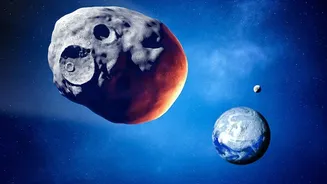
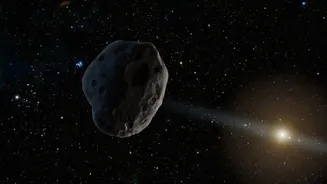
In late October 2026, the Minor Planet Center announced the verdict: 2026 QQ8 is a natural space rock. It's a tiny asteroid that flew into a region of space called Earth's Hill sphere back in April 2026. The Hill sphere is the area around a planet where its own gravity is the dominant force, strong enough to capture passing objects. Because 2026 QQ8 entered this zone, it was temporarily pulled into a chaotic, looping orbit around our planet, earning it the informal title of a 'mini-moon'. This isn't a permanent relationship, however. The asteroid is expected to continue its wobbly dance around Earth until December 2026 or early January 2027, at which point it will break free from our planet's gravitational pull and resume its own orbit around the Sun.
A Harmless, Temporary Companion
For anyone worried about this new neighbour, astronomers have offered firm reassurance: 2026 QQ8 poses absolutely no threat to Earth. At its closest point, the mini-moon is about 1.5 times farther away from us than our own Moon. Even in a worst-case scenario where its orbit changed and it headed for our planet, an object this small would completely burn up and disintegrate in the atmosphere, perhaps creating a bright fireball but causing no harm on the ground. This isn't Earth's first time hosting a temporary companion; other mini-moons like 2006 RH120 and 2020 CD3 have had similar short-term stays. These events provide valuable opportunities for scientists to study near-Earth asteroids up close, helping to refine planetary defense strategies and deepen our understanding of the cosmic neighbourhood we inhabit.