




Chasing the Universe's Ghosts
Imagine a particle so small and so neutral that it can travel for billions of light-years in a straight line, passing through planets, stars, and entire galaxies as if they were empty space. This isn't science fiction; it's a neutrino. These fundamental
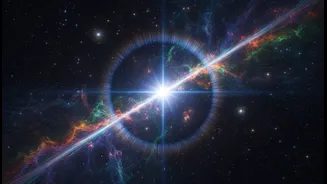
particles, often called 'ghost particles', are created in the heart of stars and other violent cosmic events. Trillions of them from our own sun pass through your body every second without you ever noticing. Because they barely interact with anything, they are incredibly difficult to detect. But this same quality makes them perfect cosmic messengers. Unlike light, which can be blocked or bent by interstellar dust and magnetic fields, neutrinos travel unimpeded, carrying pristine information directly from their source. The challenge has always been figuring out where, exactly, they came from. Catching one is hard enough; tracing its path back across the universe is a monumental task.
A Cosmic Magnifying Glass
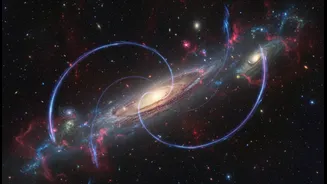
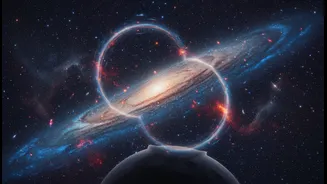
To solve this puzzle, scientists are now combining neutrino detection with one of the most fascinating phenomena in the cosmos: gravitational lensing. Predicted by Albert Einstein's theory of general relativity, gravitational lensing occurs when a massive object, like a galaxy or a cluster of galaxies, bends the fabric of spacetime itself. As light from a more distant object passes this massive body, its path is curved. This doesn't just distort the distant object's image—often smearing it into arcs or multiple images—it can also magnify it, making faint, faraway objects bright enough for our telescopes to see. This effect has been used for years to study the earliest galaxies in the universe, acting as a natural telescope far more powerful than anything we can build on Earth. By applying this concept, astronomers can now use this magnification effect to help pinpoint the location of phenomena that produce elusive particles like neutrinos.
The 'Shadow Blaster' Technique
This is where the 'Shadow Blaster Neutrino Source' method comes in. The name refers to a new strategy in multi-messenger astronomy, where scientists combine data from different kinds of signals—like light, gravitational waves, and neutrinos—to get a complete picture of a cosmic event. Recent findings have demonstrated how this works in practice. Astronomers using observatories like the Atacama Large Millimeter/submillimeter Array (ALMA) can identify a high-energy neutrino detection and then scan the patch of sky it came from. In a recent breakthrough, they found a distant galaxy whose light was being gravitationally lensed, making it appear much brighter. By analyzing the lensed image, they could confirm that this distant object was the likely source of the neutrino. This specific source was not a supermassive black hole, as often expected, but a galaxy undergoing a furious burst of star formation. This technique effectively uses the gravitational lens as a tool to cross-reference the neutrino's path with a visible, magnified source.
A Blazar in the Crosshairs
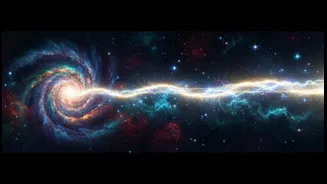
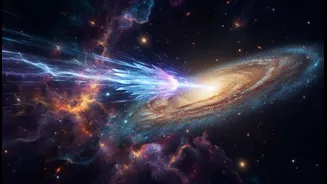
While some neutrinos are linked to starburst galaxies, many of the most powerful ones are thought to originate from blazars. A blazar is an active galactic nucleus, which means it has a supermassive black hole at its core actively feeding on gas, dust, and stars. This process creates an enormous amount of energy and shoots out a jet of ionized matter at nearly the speed of light. When one of these jets happens to be pointed directly at Earth, we call it a blazar. They are among the brightest and most energetic objects in the known universe, making them prime suspects for accelerating particles to the extreme energies required to produce high-energy neutrinos. Pioneering observatories like IceCube at the South Pole have previously found strong evidence linking specific high-energy neutrinos to flaring blazars, providing the first solid identification of a cosmic neutrino source.
A New Window to the Universe
Combining the hunt for neutrinos with the precision of gravitational lensing is a landmark achievement for multi-messenger astronomy. For over a century, the origin of the most energetic particles in the universe, known as cosmic rays, has been a major puzzle. Because neutrinos are produced along with cosmic rays, pinpointing a neutrino source also identifies a cosmic ray accelerator. This new method provides a powerful tool for doing just that. It allows scientists to look for specific types of sources, like starburst galaxies or blazars, and confirm their role in producing these ghost particles. Each successful identification adds another piece to the puzzle of the universe's most extreme environments. As our detectors become more sensitive and our analysis techniques more refined, we can expect to trace more of these messengers back to their explosive birthplaces, opening a new window onto the violent and energetic cosmos.