


A Tale of Two Poles
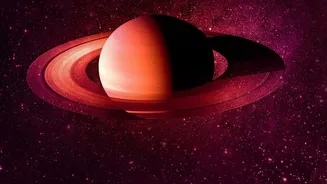
For decades, one of the most mesmerising features in our solar system has been Saturn's north pole. Encircling the top of the planet is a colossal, six-sided jet stream known as 'the hexagon'. First spotted by the Voyager mission in the early 1980s, this
feature has proven to be remarkably persistent, lasting for more than 40 years. It’s a massive structure, wide enough to fit nearly four Earths inside. Scientists have long wondered if this geometric marvel was a one-off. For years, observations of the south pole revealed no such stable, symmetrical pattern. The Cassini spacecraft, which orbited Saturn from 2004 to 2017, found no lasting polygon there. That just changed. Thanks to Saturn's shifting seasons bringing its southern hemisphere back into Earth's view, the Hubble Space Telescope has given us a fresh look, and it has found something extraordinary.
A New Shape Emerges
Recent observations from Hubble, compiled by the Outer Planet Atmospheres Legacy (OPAL) program, have confirmed the presence of a giant, 10-sided atmospheric wave at Saturn's south pole. This 'decagon' is a new development, and a surprising one at that. By analysing images dating back to 2023, scientists were able to watch the feature take shape, becoming more distinct over the last couple of years. This gives astronomers a rare opportunity: the chance to watch a giant planetary atmospheric pattern develop in near real-time. Amy Simon, a co-author of the study published in Science Advances, noted that while the northern hexagon has been a constant, this new southern feature appears to be strengthening.
How Do These Shapes Form?
These giant geometric patterns aren't solid structures, but are waves in the planet's powerful jet streams. Think of the jet streams on Earth that influence our weather, but on a much grander and more stable scale. On Saturn, these winds can reach incredible speeds. The hexagon is associated with an eastward jet moving at over 320 km/h. The cause of these polygons is believed to be a meandering wave, known as a Rossby wave, that becomes trapped and stabilised by the surrounding atmospheric flows. Laboratory experiments have successfully replicated these shapes by spinning a tank of liquid at different speeds, creating turbulence that resolves into stable polygons. The emergence of a decagon in the south, rather than another hexagon, suggests subtle but important differences in the atmospheric conditions at Saturn's two poles.
What Hubble's New View Reveals
The Hubble Space Telescope offers more than just a visible-light picture. By observing in different wavelengths, including infrared and ultraviolet, it can probe different altitudes of Saturn's atmosphere. The new observations show that the decagon is not just a surface-level cloud pattern but a vertically extended structure, reaching deep into the atmosphere much like the northern hexagon. This tells scientists it is a significant and deeply rooted atmospheric feature. Furthermore, the fact that it seems to have formed so recently has ignited curiosity. One theory is that its formation may be linked to a nearby vortex that was first observed in 2023 and darkened significantly just before the decagon became clear. The different number of sides—six in the north, ten in the south—may provide clues about the underlying differences in the planet's deep interior flows that shape its polar weather.