





The King of Moons
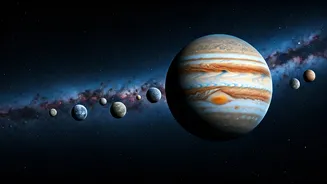
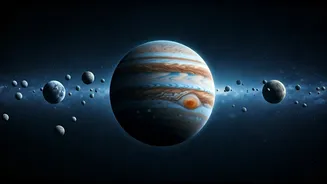
The headline-grabbing claim that Jupiter has over 90 moons is actually an understatement. As of April 2026, astronomers have confirmed the existence of 115 moons orbiting the gas giant, with the number steadily climbing as our detection methods improve.
[1] In fact, recent discoveries in March and April 2026 alone added 18 new moons to the tally. [2, 8] This ever-growing collection of satellites is a key reason why scientists refer to the Jovian system as a 'mini solar system'. [19] At the center is a massive, dominant body—Jupiter—which is twice as massive as all other objects in our solar system combined, excluding the Sun. [19] Orbiting it is a vast and varied court of moons, from planet-sized worlds to small, captured asteroids. [14]
The Stars of the Show: The Galilean Moons
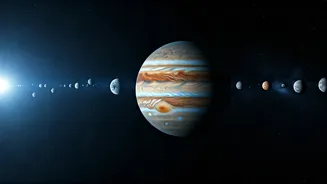
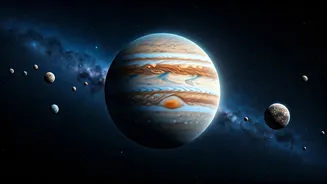
The four largest and most famous of Jupiter's moons are the Galilean satellites, discovered by Galileo Galilei in 1610. [6] This discovery was monumental, as it provided the first clear evidence of celestial bodies orbiting something other than Earth. [11] These four moons are worlds in their own right, each with distinct and fascinating characteristics. Io is the most volcanically active body in the entire solar system, with hundreds of volcanoes spewing sulfurous plumes. [9, 11] Europa is covered by a crust of water ice, beneath which scientists strongly believe lies a vast liquid water ocean, making it a prime candidate in the search for extraterrestrial life. [11, 9] Ganymede is the largest moon in our solar system—bigger than the planet Mercury—and is the only moon known to have its own magnetic field. [11] Finally, Callisto is a heavily cratered, ancient world, its surface a frozen record of the early history of the solar system. [9] This diversity of large, spherical bodies mirrors the variety of the terrestrial planets orbiting our Sun. [6]
A Swarm of Smaller Worlds
Beyond the big four, Jupiter is orbited by over 100 much smaller, irregular moons. [1, 8] Most of these are tiny, measuring just a few kilometers in diameter, and are thought to be asteroids or comets captured by Jupiter's immense gravity long ago. [14, 4] Many of these smaller moons have unusual orbits; some travel in the opposite direction of Jupiter's rotation (retrograde orbits) or at highly inclined angles. [14] These captured worlds often group together in 'families' with similar orbits, suggesting they are fragments of larger bodies that broke apart during capture or from later collisions. [7] Astronomers like Scott Sheppard have been instrumental in finding these faint, distant moons using powerful telescopes, constantly pushing the official count upwards. [2, 5]
What Makes It a 'Mini Solar System'?
The analogy of a 'mini solar system' is fitting for several reasons. [10, 19] Firstly, there's the architecture: a single, massive central body whose gravity dictates the orbits of everything else in its system. [19] Secondly, there's the diversity of its satellites. The inner Galilean moons are large, planet-like worlds, while the outer regions are filled with a swarm of smaller, irregular bodies, akin to our own solar system's asteroid belt and Kuiper Belt objects. [1, 7] The orbital mechanics also show parallels; the inner three Galilean moons are locked in an orbital resonance, where their gravitational pulls on each other maintain a stable, predictable pattern. [7] This complex, gravitationally-bound system, with its mix of large and small bodies formed in different ways, is a perfect microcosm for studying how planetary systems—including our own—form and evolve. [19]