






First, Prepare for the Night
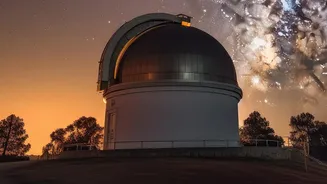
The most crucial tool for stargazing isn't a lens, but a dark sky. Light pollution from cities washes out all but the brightest objects. If possible, drive a short distance away from city lights for a dramatically better view. Once you've found your spot,
give your eyes 20-30 minutes to fully adjust to the darkness. This process, called dark adaptation, significantly increases your ability to see fainter stars. Avoid looking at your phone screen, as its white light can reset your night vision instantly. If you need light, use a red-light flashlight or a phone app with a red-light mode, which preserves your adjusted vision. Many free stargazing apps can also help you get oriented by identifying objects when you point your phone at the sky.
Stars vs. Planets: The Twinkle Test
One of the simplest and most effective ways to tell a planet from a star is the 'twinkle test'. Stars are so far away that they appear as tiny points of light. As their light travels through Earth's turbulent atmosphere, it gets bent and distorted, causing them to twinkle or shimmer. Planets in our solar system are much closer. To our eyes, they appear as tiny, steady discs of light rather than points. This makes them less susceptible to atmospheric distortion, so they tend to shine with a constant, unwavering glow. If you spot a bright object that isn't twinkling, you're very likely looking at a planet.
The Five Brightest Planets
Five planets are readily visible to the naked eye: Mercury, Venus, Mars, Jupiter, and Saturn. Venus is often the most brilliant object in the sky after the Sun and Moon, appearing as a blazing, silvery-white light in the west after sunset or in the east before sunrise. Jupiter is also exceptionally bright, with a steady, commanding presence. Mars is famous for its distinct reddish or pale pink hue. Saturn appears as a bright, yellowish-white point of light, while Mercury is trickier to spot as it always stays close to the horizon around sunrise or sunset. Their positions change, so using a sky map app can help you locate which ones are currently visible.
Find Anchors in the Sky
Trying to learn the entire sky at once is overwhelming. Instead, start by finding a few easy-to-recognize patterns, or 'asterisms'. The Big Dipper (part of the Ursa Major constellation) is one of the most famous and is visible year-round in the Northern Hemisphere. Its seven bright stars form a clear ladle shape. The two stars at the end of the Dipper's bowl point directly to Polaris, the North Star. Another excellent starting point, especially in winter, is Orion the Hunter. Look for its three bright stars in a straight line, which form Orion's Belt. These anchor patterns can help you navigate the rest of the celestial map.
Go Beyond Stars and Planets
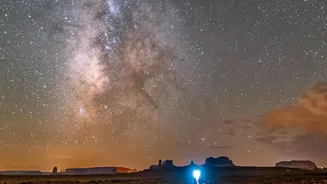
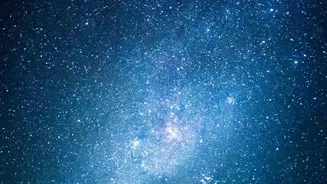
With just your eyes, you can witness more than just stars and planets. On a clear, moonless night in a truly dark location, you might see the Milky Way arching across the sky—a breathtaking, hazy band composed of billions of distant stars. Throughout the year, Earth passes through trails of debris left by comets, resulting in meteor showers. These 'shooting stars' are best viewed after midnight during their peak, with major annual events including the Perseids in August and the Geminids in December. You can also spot the International Space Station (ISS). It looks like a very bright, fast-moving star gliding silently across the sky, typically for a few minutes around dawn or dusk. Unlike an airplane, its light is solid and doesn't blink.