



A Cosmic Firestorm Next Door
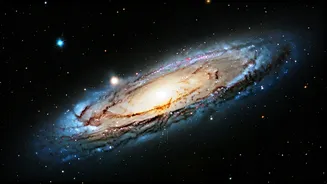
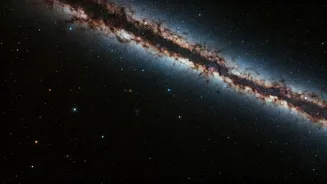
Located about 12 million light-years away in the constellation Ursa Major, Messier 82 (M82), or the Cigar Galaxy, is our closest look at a cosmic phenomenon known as 'starburst'. This galaxy is creating new stars ten times faster than our own Milky Way.
This frantic pace is believed to be the result of a gravitational tug-of-war with its larger neighbour, M81, millions of years ago. This cosmic interaction funnelled enormous amounts of gas into M82's core, providing the raw fuel for a spectacular, but temporary, burst of star creation that makes the galaxy shine five times brighter than the Milky Way.
Webb's Infrared Advantage
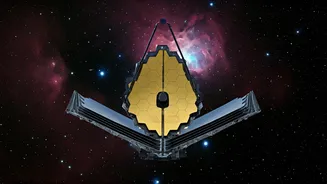
In visible light, much of the action in the Cigar Galaxy's core is hidden behind thick clouds of gas and dust. This is where the James Webb Space Telescope (JWST) and its powerful Near-Infrared Camera (NIRCam) come in. Infrared light, which has longer wavelengths than visible light, can penetrate these obscuring clouds. This allows astronomers to see what's happening inside the galaxy's stellar nurseries in unprecedented detail. By dedicating over 65 hours of observation time, Webb has effectively drawn back the curtain on M82, revealing not just the glow of gas but millions of individual stars.
Riding the Galactic Superwind
One of the most dramatic features revealed by Webb is the galaxy's 'superwind'. This is a massive outflow of gas and other material being blasted out from the galaxy's core, powered by the collective force of the new stars and the supernovae of older, massive stars. The new images trace this wind in fiery red and orange hues, showing it extending far above and below the galactic disk in a sort of hourglass shape. These plumes are not just a uniform haze; Webb's resolution shows they are made of distinct clumps and filaments. This intricate structure gives scientists a clearer view of how a galaxy's intense star-forming activity can reshape its own environment, ironically expelling the very material needed for future star birth.
The Glow of Cosmic Soot
A key part of the 'infrared science' in action is the ability to map specific chemical compounds. The reddish-orange filaments in the outer parts of the wind are traced by the glow of polycyclic aromatic hydrocarbons (PAHs). You can think of PAHs as a kind of complex cosmic soot, molecules that are very common in space. When they are hit by the radiation from young, hot stars, they glow brightly in infrared light. By tracing the location and structure of these PAH emissions, astronomers can understand how energy and matter are being transported out of the galaxy's core and into the space between stars. These are the building blocks for future cosmic structures, and Webb is watching them get carried away on the wind.
A Fossil Record of a Galaxy
By resolving approximately 16.5 million individual stars, Webb is giving astronomers a fossil record of M82's turbulent history. The distribution and age of these stars can tell a story about how the starburst started and how it has progressed over millions of years. These detailed observations help scientists test and refine their models of galaxy evolution. Starburst galaxies like M82 are thought to be common in the early universe, so understanding this relatively close example provides a crucial window into how the very first galaxies grew and changed. Every new detail helps answer fundamental questions about how galaxies work and how they came to be.