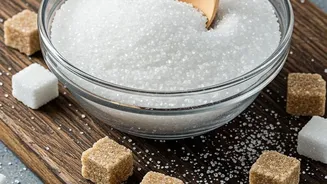







First, What Are 'Free Sugars'?
Before we can compare honey and sugar, it's crucial to understand the term 'free sugars'. According to the World Health Organization (WHO), this category includes any sugars added to food by a cook, manufacturer, or consumer. It also, importantly, covers
sugars that are naturally present in honey, syrups, fruit juices, and fruit juice concentrates. These are 'free' because they are no longer locked inside the cellular structure of a whole food, like the sugars in an intact apple or carrot. Health bodies recommend limiting free sugars because excessive consumption is linked to health issues like unhealthy weight gain and dental cavities.
The Chemical Composition of Honey vs. Sugar
At a molecular level, honey and table sugar are surprisingly similar. Table sugar, or sucrose, is a disaccharide made of two sugar molecules bonded together: 50% glucose and 50% fructose. Honey is also primarily composed of glucose and fructose, but they exist as separate single sugar molecules (monosaccharides). Honey's composition is roughly 80% sugar, with the remainder being water and trace amounts of other compounds. So, while the structure is slightly different, the fundamental building blocks your body gets from both are the same: glucose and fructose.
How Your Body Metabolises Them
When you eat table sugar, your body has to break the sucrose bond to separate the glucose and fructose before they can be absorbed. Since the sugars in honey are already separate, this step is skipped, making them slightly easier for the body to absorb directly. However, the end result is the same. In both cases, your bloodstream receives a rush of simple sugars. Health authorities are clear: for metabolic purposes, honey is treated as an added sugar. The American Heart Association, for example, counts honey toward its daily limit for added sugars.
The Glycemic Index and Calorie Count
The Glycemic Index (GI) measures how quickly a food raises blood sugar levels. Table sugar has a GI of around 65-80, while honey's GI is typically a bit lower, averaging around 50-60. This means honey may raise your blood sugar slightly more slowly than sugar, but the effect is not dramatic and can vary widely depending on the type of honey. Calorie-wise, honey is more calorie-dense. A tablespoon of honey contains about 64 calories, compared to about 49 calories in a tablespoon of sugar. This is because honey is denser than granulated sugar. However, since honey is often perceived as sweeter, some people may use less of it, potentially balancing out the calorie difference.
Does Honey Have Any Extra Benefits?
This is where honey has a slight edge. Unlike refined sugar, which offers 'empty calories' with no nutritional value, raw honey contains trace amounts of vitamins, minerals, enzymes, and antioxidants like flavonoids and phenolic acids. Darker honeys tend to contain more antioxidants than lighter ones. Some research also supports honey's traditional use for soothing coughs and sore throats and its potential antimicrobial properties. However, it's vital to keep this in perspective. The quantities of these beneficial compounds in a typical serving of honey are very small and not enough to significantly impact your overall nutrient intake.
The Verdict: Moderation Remains Key
While honey offers some minor advantages over refined sugar—a slightly lower GI and trace amounts of nutrients and antioxidants—it is still classified as a 'free sugar'. Your body processes it in much the same way as table sugar, and it contributes to your daily calorie and sugar intake similarly. Swapping sugar for honey is not a free pass to consume more sweetener. The most beneficial health choice is to reduce your overall intake of all free sugars, regardless of whether they come from a sugar bowl or a honey pot. When you do use a sweetener, choosing raw honey over sugar means you're getting a tiny bit more nutritional value, but moderation is what truly matters.