
Venus: The Hostile Twin
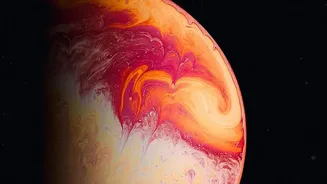
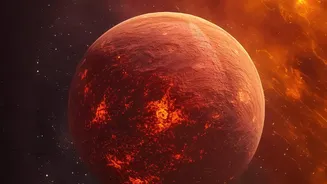
Imagine a planet almost identical in size to Earth, yet one of the most inhospitable places in the solar system. That’s Venus. Its atmosphere, over 90 times denser than Earth's, is a toxic blend of mostly carbon dioxide with clouds of corrosive sulfuric
acid. This creates a runaway greenhouse effect, pushing surface temperatures to a scorching 460 degrees Celsius—hot enough to melt lead. The immense pressure is equivalent to being nearly a kilometre deep in our ocean. This hellish environment, combined with the thick, opaque clouds, makes studying Venus incredibly challenging. For decades, these conditions have hidden the planet’s surface from conventional telescopes, leaving critical questions about its geology and evolution unanswered.
Shukrayaan: India's Ambitious Answer
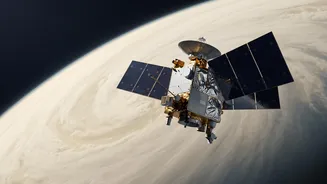
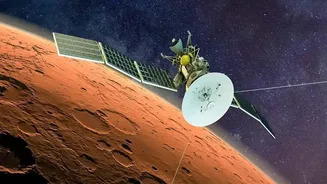
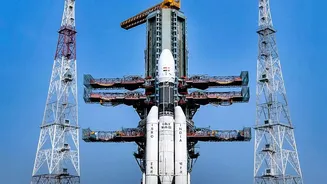
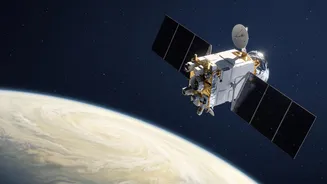
Enter Shukrayaan-1, the Venus Orbiter Mission from the Indian Space Research Organisation (ISRO). Following the historic success of the Mars Orbiter Mission (Mangalyaan), Shukrayaan is India’s next major leap in interplanetary exploration. Formally approved by the government, the mission is slated for a 2028 launch. The primary goal is to conduct a comprehensive four-year study of Venus from orbit. The mission aims to map the planet's surface and subsurface, analyse the complex chemistry of its atmosphere, and study the interaction between Venus and the ever-present solar wind. To achieve this, the orbiter will carry a payload of around 100 kg, comprising approximately 19 scientific instruments from India and international partners like Russia, France, Sweden, and Germany.
The All-Seeing Radar Eye
The key to peering through the dense Venusian clouds lies in radar technology. Shukrayaan's flagship instrument is a high-resolution Synthetic Aperture Radar (SAR). Unlike optical cameras that need light and a clear view, SAR works by sending radio wave pulses towards the planet's surface and capturing the returning echoes. By processing these signals, scientists can construct detailed, high-resolution 3D maps of the terrain, regardless of cloud cover or whether it's day or night. This technology is not new, but Shukrayaan’s SAR is expected to be a significant upgrade, offering much higher resolution than NASA’s Magellan orbiter from the 1990s. This will allow for an unprecedented look at Venus’s geological features, like volcanoes and lava flows, helping to reveal its volcanic and tectonic history.
A World-First Peek Beneath the Surface
Shukrayaan is set to make history with another pioneering instrument: a ground-penetrating radar. This will be the first time any mission has studied the subsurface of Venus. While the SAR maps the surface topography, the ground-penetrating radar will send lower-frequency waves deeper into the crust. This will provide insights into the planet’s shallow subsurface stratigraphy—the layering of rock and other deposits. By understanding what lies beneath the immediate surface, scientists hope to piece together the geological evolution of Venus and understand why our twin planet turned out so differently from Earth.
Decoding the Atmosphere
Beyond mapping the ground, a major focus is the atmosphere itself. The mission will carry a suite of spectroscopic instruments to analyse the composition of the dense air and clouds. One key instrument is the Venus Infrared Atmospheric Gases Linker (VIRAL), a collaborative effort between France and Russia. This sensor will study the atmospheric chemistry in detail. It will also be capable of searching for specific gases, like phosphine, which has been speculatively detected and is considered a potential, though highly debated, biosignature. Other tools, like the Venusian Neutrals Analyzer from Sweden, will study how the solar wind strips away particles from the upper atmosphere, helping explain how Venus lost its water over billions of years.