






The Challenge of Coming Home
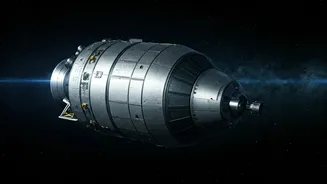
Sending rockets to space is complex, but bringing them back in one piece presents a unique and dangerous set of problems. A returning module, whether carrying astronauts or expensive equipment, hits the Earth's atmosphere at hypersonic speeds, potentially
over 25 times the speed of sound. This compresses the air in front of it, generating temperatures hot enough to melt steel. The vehicle must be slowed dramatically and stabilized to prevent it from burning up or losing control. This is where the concept of 'celestial returns' becomes a critical field of engineering. For India's ambitious spaceflight programs, including the Gaganyaan human spaceflight mission and the Reusable Launch Vehicle (RLV) program, mastering this phase is non-negotiable. The lives of astronauts and the success of future, more cost-effective missions depend on it.
What Are Aerospace Drop Assessments?
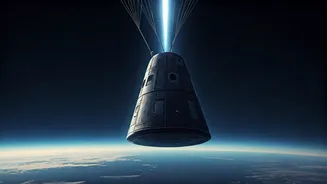
An aerospace drop assessment is essentially a dress rehearsal for the final, critical moments of a spacecraft's return. In these tests, a replica or boilerplate version of a crew capsule or vehicle is lifted to a specific altitude, typically by a heavy-lift helicopter or transport aircraft, and then released. This controlled drop allows engineers to test the vehicle's descent and landing systems in a real-world environment without the expense and risk of a full orbital launch. The primary focus is often on the parachute system, which is the key to slowing the craft for a gentle splashdown or landing. These are not simple tests; they are highly complex operations involving multiple government agencies, including the Indian Air Force for transport and the Navy for recovery operations. Each test is designed to validate specific components and sequences under realistic conditions.
A Symphony of Parachutes
The Gaganyaan crew module's deceleration system is a prime example of the complexity involved. It doesn't rely on just one parachute, but a sequence of ten parachutes of four different types that deploy in a precise, automated sequence. The process begins with two Apex Cover Separation parachutes, which pull away the cover protecting the main chutes from the heat of re-entry. Next, two Drogue parachutes deploy to stabilize the rapidly descending module and provide the initial, significant reduction in speed. Following this, three pilot parachutes are released to pull out the three massive main parachutes. It is this final trio of main chutes that slows the module to a safe velocity for a splashdown in the sea. Recent tests, such as the Integrated Main Parachute Airdrop Test (IMAT) series, specifically target the performance and structural integrity of these main parachutes under maximum expected loads.
Building Confidence Through Repetition
The word 'continuous' in the headline is key. ISRO conducts a series of these drop tests to build a robust database of performance metrics. Each test, whether it's an Integrated Air Drop Test (IADT) or an IMAT, is designed to qualify the systems step-by-step. For instance, a recent test in July 2026 was the fifth in the IMAT series, where a dummy mass was dropped from an IL-76 aircraft at an altitude of 2.5 km to test the main parachute. By repeating these tests under slightly different conditions and simulating potential failures, engineers can establish reliability benchmarks. This data-driven approach provides the confidence that every component will function exactly as designed during an actual mission, especially the first uncrewed Gaganyaan (G1) flight, where system performance is paramount.
Beyond Gaganyaan: The Reusable Future
While astronaut safety for Gaganyaan is the immediate priority, these assessments also lay the groundwork for ISRO's other great ambition: a fully reusable launch vehicle. The RLV program, featuring the winged vehicle 'Pushpak', also relies on mastering atmospheric re-entry and autonomous landing. The RLV Landing Experiments (LEX) involve releasing the prototype from a helicopter at 4.5 km altitude to test its ability to navigate and perform a precise, high-speed horizontal landing on a runway, much like an aircraft. These tests have successfully demonstrated autonomous landing capabilities even under challenging wind conditions and have validated the advanced guidance algorithms needed for a vehicle returning from orbit. The data from both the Gaganyaan drop tests and the RLV landing experiments create a deep well of knowledge for all future 'celestial returns'.