




The Himalayan Water Paradox
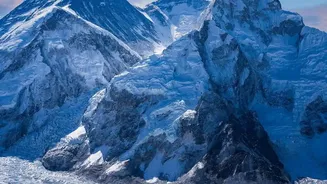
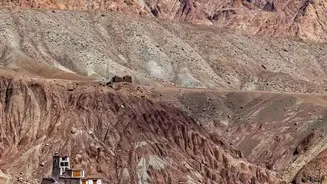
Ladakh is a cold desert, receiving minimal rainfall and depending almost entirely on snow and glacier melt for its water needs. For centuries, farmers timed their sowing of barley and other crops with the arrival of meltwater in late spring and early
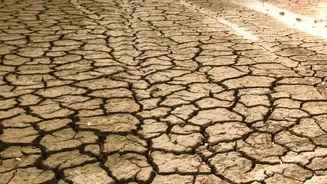
summer. But climate change has severely disrupted this ancient rhythm. Glaciers are retreating and winter snowfall has become less predictable. The most critical problem is one of timing: much of the snow now melts and flows away unused before the planting season begins, while the crucial glacier melt arrives too late. This creates a dangerous water gap in April and May, leaving fields parched precisely when they need water the most.
An Ingenious Solution
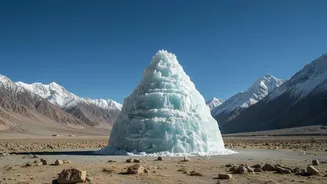
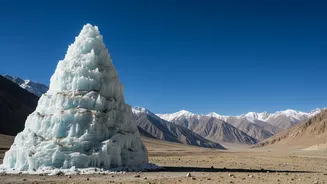
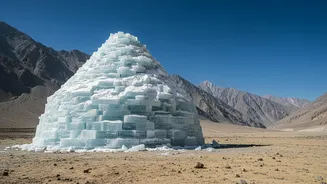
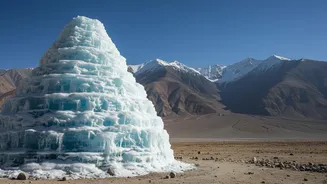
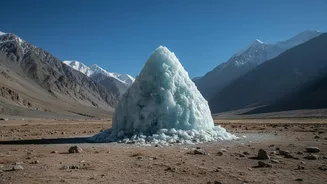
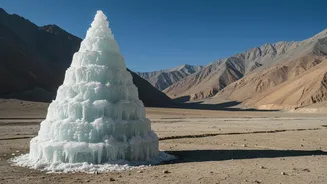
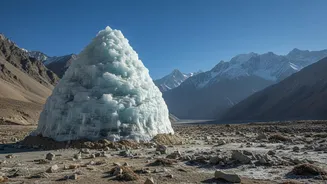
Enter the ice stupa, a revolutionary concept pioneered by Ladakhi engineer and innovator Sonam Wangchuk. Inspired by the sight of ice persisting under a bridge well into late spring, Wangchuk developed a method to create artificial glaciers at lower altitudes. Named for their resemblance to traditional Buddhist stupas, these conical ice structures are designed to store the abundant, otherwise wasted stream water from winter and release it slowly during the spring melt. The first prototype, built in 2013, successfully stored 150,000 litres of water and lasted until mid-May, proving the concept's viability.
The Science of Simplicity
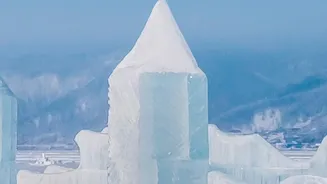
The technology behind ice stupas is remarkably simple and requires no electricity or pumps. A pipe is laid to divert water from a stream at a higher elevation during the winter months. Due to gravity and the height difference, the water flows down the pipe and, when channelled upwards through a vertical pipe at a lower point, sprays out like a fountain. In Ladakh's sub-zero winter temperatures, this water freezes almost instantly as it falls, gradually forming a massive cone of ice around the pipe. The conical shape is geometrically efficient, exposing the minimum possible surface area to the sun, which ensures the ice melts much slower than a flat field of ice would.
From Concept to Community Lifeline
The ice stupa project, undertaken by Wangchuk's NGO, the Students' Educational and Cultural Movement of Ladakh (SECMOL), has quickly scaled from a single prototype to a community-wide movement. Villages across Ladakh now build their own ice stupas, sometimes as part of a friendly competition, to secure their water supply. These artificial glaciers can store millions of litres of water, which becomes available for irrigating fields of barley, apples, apricots, and poplars just as the growing season starts. In 2015, meltwater from an ice stupa was used by villagers to plant 5,000 tree saplings, turning a barren patch of desert green. The technology empowers local communities, giving them a practical tool to adapt to the realities of climate change and secure their agricultural livelihoods.
A Model for a Warming World
The success of Ladakh's ice stupas has captured global attention. The simple, low-cost, and community-driven approach is a powerful example of climate adaptation. The technology has been replicated in other parts of the Himalayas and even as far as the Swiss Alps and the Chilean Andes. It demonstrates that local, indigenous knowledge, when combined with modern engineering principles, can yield profound solutions to global problems. More than just a water storage technique, the ice stupa has become a symbol of hope and resilience, proving that human ingenuity can help communities not only survive but thrive in the face of environmental challenges.