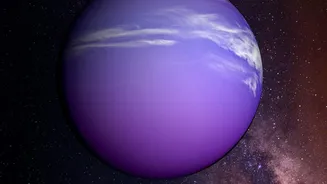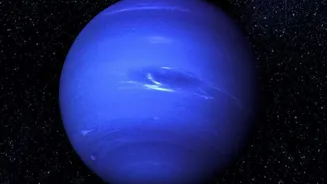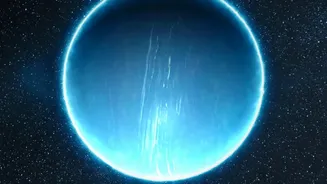






What Exactly is a Warm Neptune?
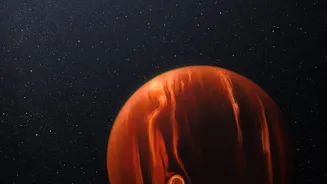
Imagine a planet roughly the size of our own Neptune or Uranus. Now, picture it taken from the cold, distant suburbs of its solar system and pushed into a scorching-hot orbit, much closer to its star than Mercury is to our sun. That's a 'warm Neptune'.
These worlds are a cosmic puzzle. They are gas giants, but they exist in a region where intense stellar radiation should, in theory, blow their thick atmospheres away over billions of years. Some, called 'hot Neptunes,' orbit so closely their year lasts less than a day. Their very existence challenges our understanding, suggesting a more dramatic and complex history than planets in our own solar system experienced. Astronomers believe they likely didn't form where we see them now, but instead migrated inward from the colder, outer regions of their star system.
Why Methane is a Telltale Clue
On its own, methane is a simple molecule made of one carbon atom and four hydrogen atoms. It’s abundant in our own solar system’s gas giants. However, in the atmosphere of a distant exoplanet, its presence or absence acts like a chemical fingerprint, telling a detailed story about the planet’s history and environment. Methane’s stability is highly dependent on temperature. In the cooler outer regions of a solar system, carbon is likely to grab hydrogen to form methane. Closer to a star, where it's hotter, carbon prefers to bond with oxygen, forming carbon monoxide and carbon dioxide. Therefore, finding significant methane on a warm planet is unexpected. It suggests the planet's chemistry is not in equilibrium with its current hot environment, hinting that its atmospheric ingredients were locked in when it formed in a much colder place.
A Surprising Atmospheric Cocktail
The James Webb Space Telescope (JWST) has been a game-changer, allowing scientists to analyze the chemical makeup of exoplanet atmospheres with unprecedented detail. Using a technique called transmission spectroscopy, the telescope observes the starlight that filters through a planet's atmosphere during a transit. Different molecules absorb light at specific wavelengths, leaving a unique barcode that JWST can read. In recent observations of warm Neptune and sub-Neptune class planets, like WASP-80 b, JWST has made definitive detections of methane where it was previously elusive. For years, astronomers were puzzled by the lack of methane on some of these worlds, leading to theories about photochemical destruction or unusual atmospheric mixing. The new, clear detections confirm that methane is present, forcing scientists to confront what this means for their formation models.
Rewriting the Planetary Playbook
The leading theory of giant planet formation is 'core accretion'. In this model, a large core of rock and ice, about 10 times Earth's mass, forms first. Once it's massive enough, its gravity rapidly pulls in huge amounts of surrounding hydrogen and helium gas to form a thick atmosphere. The chemical composition of that atmosphere should reflect where it formed. The detection of abundant methane on a warm Neptune strongly supports the idea that these planets are cosmic migrants. They must have formed far out in their solar systems, beyond the 'ice line,' where temperatures were low enough for methane and water to exist as ices. These icy bodies, rich in carbon, would have been the building blocks of the planet's core and atmosphere. The planet would have later spiraled inward toward its star, but its atmosphere retained the chemical memory of its cold birthplace. This new data helps refine these migration models, providing concrete evidence that planets can and do move significantly over their lifetimes.