
For decades, we've understood the universe to be about 13.8 billion years old. Now, a provocative study from the University of Ottawa challenges that fundamental number, suggesting our cosmos might actually be 26.7 billion years old.
A Radical New Timeline
The standard story
of the universe begins with the Big Bang, an explosive start that set the cosmic clock ticking approximately 13.8 billion years ago. This age is a cornerstone of the Lambda-CDM model, the remarkably successful framework scientists use to describe the cosmos. But what if that clock is wrong? Rajendra Gupta, a physics professor at the University of Ottawa, has put forward a new model that nearly doubles the universe's age. This isn't just a minor adjustment; it's a fundamental rethinking of cosmic history that could resolve some of the most stubborn puzzles in modern astronomy.
The 'Impossible' Galaxy Problem
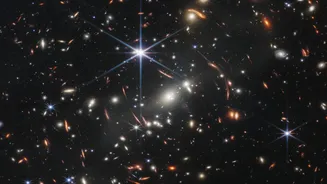
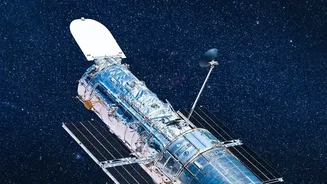
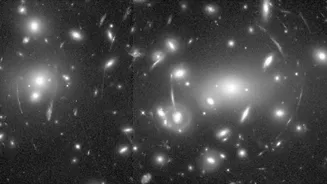
The motivation for this bold new theory comes from some puzzling recent discoveries. NASA's James Webb Space Telescope (JWST) has been peering into the farthest reaches of space, observing galaxies from the universe's infancy. The problem is, some of these ancient galaxies appear far too massive and mature. They look like they've had billions of years to develop, yet according to the standard model, they existed when the universe was just a few hundred million years old. This 'impossible early galaxy problem' has left astronomers scrambling for an explanation. Gupta's model offers a straightforward one: these galaxies seem mature because they are. If the universe is 26.7 billion years old, these early galaxies had billions, not millions, of years to form.
Reviving 'Tired Light'
To build his case, Gupta combines two ideas, one old and one new. The old idea is the 'tired light' theory, first proposed by astronomer Fritz Zwicky in 1929. Zwicky suggested that the redshift we observe from distant galaxies—the stretching of light towards the red end of the spectrum—isn't just because the universe is expanding. He theorized that light simply loses energy, or gets 'tired', as it travels across billions of light-years. This theory was largely dismissed because it couldn't explain other key cosmic observations. However, Gupta doesn't suggest replacing cosmic expansion with tired light; he proposes that the two phenomena coexist. In his view, the redshift we see is a hybrid effect of both expansion and tired light.
Evolving Forces of Nature
The second, newer idea in Gupta's model involves 'covarying coupling constants' (CCC). This is the notion that the fundamental forces of nature, which we assume are constant, might actually change over time. By allowing these constants to evolve, the model can describe the universe without needing two of the most mysterious ingredients in modern physics: dark matter and dark energy. In the standard model, dark energy is the unseen force driving the accelerating expansion of the universe, and dark matter is the invisible mass that provides the extra gravitational pull needed to hold galaxies together. Together, they are thought to make up 95% of the cosmos, yet they have never been directly detected. Gupta's CCC+TL model suggests the effects we attribute to them might just be the result of physical laws behaving differently in the distant past.
What Does This All Mean?
If proven correct, this new model would be revolutionary. It would not only resolve the JWST's 'impossible galaxy' paradox but could also eliminate the need for the elusive dark matter and dark energy. Researchers Gupta and Nikolaos Samaras have tested their CCC+TL model against several observations, including the rotation of galaxies and the expansion history of the universe, and found it holds up. However, this is still a highly unconventional proposal that challenges a century of established cosmology. The Lambda-CDM model remains incredibly successful at explaining a vast range of cosmic phenomena. For Gupta's theory to gain acceptance, it will need to survive intense scrutiny and be tested against all major observations, including the Cosmic Microwave Background—the faint afterglow of the Big Bang.