



A Hero's Valiant Stand
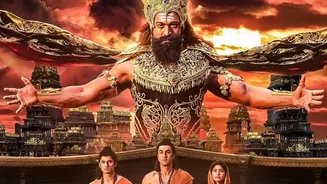
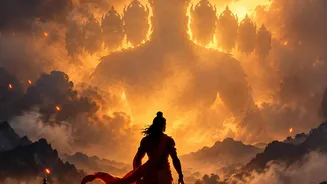
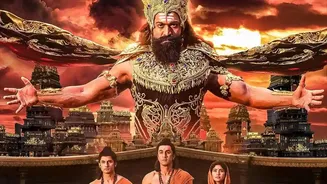
The story is one of the most dramatic in the Ramayana. As the demon king Ravana abducts Sita and flies towards Lanka in his celestial chariot, his path is blocked by an aged but mighty vulture, Jatayu. A dear friend of Lord Rama's father, King Dasharatha,
Jatayu could not stand by and watch the injustice. He fought fiercely with Ravana, shattering his chariot and momentarily thwarting the powerful king. But the battle was uneven. Ravana, with his divine sword, ultimately clipped Jatayu's wings, leaving him mortally wounded. He fell to the earth, living just long enough to inform Rama and Lakshmana of Sita's abduction and the direction of Ravana's flight, providing a crucial clue in their quest.
The Kerala Connection: Chadayamangalam
Perhaps the most famous site associated with Jatayu's fall today is Chadayamangalam in Kollam district, Kerala. Local tradition strongly holds that this is the rock—or 'para'—where the grievously injured Jatayu landed. The name itself is believed to have evolved from 'Jatayumangalam'. This belief has been immortalised by the Jatayu Earth's Center, a tourism park that features the world's largest bird sculpture. The colossal statue, measuring 200 feet long, depicts Jatayu lying on his back, wings broken, in his final moments. The site is not just a modern attraction; it has long been a place of pilgrimage, with a temple dedicated to Lord Rama and a waterbody believed to have been formed by the strike of Jatayu's beak.
Andhra's Claim: The Lepakshi Footprint
Another powerful claimant is Lepakshi in Andhra Pradesh, a town renowned for its stunning Veerabhadra temple from the Vijayanagara era. According to local folklore, this is where Rama found the dying Jatayu. In an act of compassion, he is said to have uttered the words 'Le Pakshi', which means 'Rise, bird' in Telugu, giving the village its name. While Chadayamangalam focuses on the fall, Lepakshi's legend is tied to Rama's encounter with the fallen hero. Adding to the mystique, the area features a large footprint in the rock, which some locals believe belongs to Sita or Hanuman. A large Jatayu statue and theme park have also been developed here to commemorate the legend.
Echoes in Tamil Nadu and Maharashtra
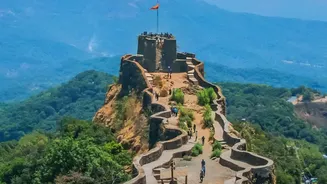
The claims do not end there. In Tamil Nadu, two towns are connected to Jatayu's final moments. Thiruputkuzhi near Kanchipuram is believed to be where Rama performed Jatayu's last rites, an honour given to a father figure. The town's name is said to derive from 'pul' (bird) and 'kuzhi' (pit), referring to Jatayu's cremation pyre. The Vijayaraghava Perumal Temple at this site commemorates this event. Farther north, some traditions point to the area of Janasthana near Nashik in Maharashtra, in the Dandaka forest where Rama, Sita, and Lakshmana spent their exile, as the original location of the battle.
A Legend Rooted in Faith, Not Maps
Why do so many places lay claim to a single mythological event? The answer lies in the nature of an epic like the Ramayana. As the story was passed down through generations, it was woven into the fabric of local communities across the subcontinent. Each region embraced the epic, connecting its own sacred geography to the divine narrative. Attaching a significant event like Jatayu's fall to a local hill or rock made the story tangible and cemented the area's place within the grand tradition of the epic. The multiple locations, therefore, do not contradict each other as much as they highlight the profound and widespread cultural impact of the Ramayana. They show how faith can turn a landscape into a sacred space.