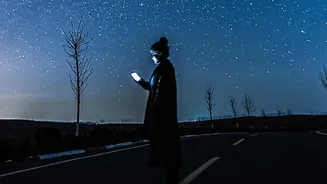








A Planetarium in Your Pocket
For many young people in bustling Indian metropolises, the universe felt distant and inaccessible, hidden behind a persistent veil of light and air pollution. Now, the cosmos is just a tap away. A suite of powerful and user-friendly skywatching apps like
SkyView, Star Walk, and Stellarium are transforming smartphones into personal planetariums. These applications use a phone's built-in gyroscope, compass, and GPS to pinpoint its exact location and orientation. When you point your device towards the sky, the app overlays a map of celestial objects, identifying stars, constellations, planets, and even satellites in real-time. This technology demystifies the night sky, making astronomy accessible to anyone with a phone, no expensive telescope required.
Seeing Through the City Glow
The biggest challenge for any urban astronomer is light pollution, which can wash out all but the brightest stars. This is where augmented reality (AR) becomes a game-changer. Skywatching apps use AR to superimpose constellations and celestial bodies onto the user's view of the sky. Even if a star is invisible to the naked eye due to the city's glow, the app can show you exactly where it is, labeling it and tracing the constellation it belongs to. Some apps even feature a red-light mode to help preserve night vision during observation. This allows young enthusiasts in cities like Mumbai, Delhi, and Bengaluru to learn the sky map from their balconies or rooftops, identifying objects they otherwise wouldn't know were there.
More Than Just Stargazing
The appeal of these apps goes far beyond simple identification. They are rich educational tools packed with features that encourage sustained engagement. Users receive notifications for upcoming celestial events like meteor showers, eclipses, and visible passes of the International Space Station (ISS). Many apps include detailed information on the mythology and science behind constellations, the history of celestial discoveries, and 3D models of planets and deep-sky objects. This transforms a passive viewing experience into an active learning journey, fostering scientific curiosity and critical thinking skills. Apps like 'Bhagol' and 'Indian Sky Map' even cater specifically to an Indian audience, mapping the sky with traditional nakshatras and rashis.
A Cure for Urban Disconnect
Beyond the technology, this trend speaks to a deeper need for connection—with nature, with history, and with something larger than oneself. For a generation growing up in a fast-paced, digital-first world, stargazing offers a moment of mindfulness and awe. Studies have shown that experiencing the vastness of the night sky can reduce stress and inspire creativity. The hobby, while often starting as a solo activity, is also fostering communities. Young observers share their astrophotography on social media, join online forums to discuss their findings, and connect with local astronomy clubs, some of which are seeing a renewed interest from younger members. This blend of digital discovery and real-world connection is proving to be a powerful combination.