




The Universe’s 'Goth' Objects
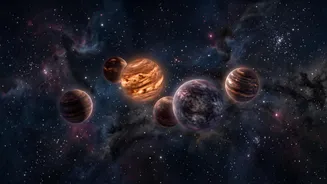
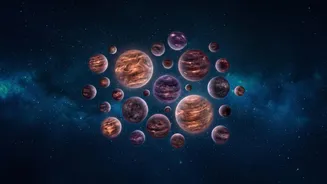
Brown dwarfs occupy a mysterious middle ground in the cosmos. They form from collapsing clouds of gas and dust, just like stars, but never gain enough mass to kickstart the hydrogen fusion that makes stars shine. Instead of burning brightly, they are
heated by their own internal energy, glowing dimly and cooling over billions of years. With masses somewhere between 13 and 80 times that of Jupiter, they are too small to be stars but significantly larger than gas giant planets. Many drift through space alone, untethered to a host star, leading some scientists to affectionately call them 'goth' objects. This independence makes them fascinating subjects, as their properties aren't influenced by a nearby star's radiation, giving us a clearer window into their nature. First theorized in the 1960s and discovered in the 1990s, thousands of brown dwarfs have now been identified, but studying them in detail has remained a challenge due to their faintness.
Seeing the Invisible with SPHEREx
Because brown dwarfs are relatively cool, they emit most of their light in the infrared spectrum, which is invisible to the human eye. This is where NASA's SPHEREx (Spectro-Photometer for the History of the Universe, Epoch of Reionization, and Ices Explorer) telescope comes in. Launched in March 2025, SPHEREx is on a mission to map the entire sky in infrared light, a task that is difficult to perform from the ground because water in Earth's atmosphere absorbs many of these wavelengths. For a recent study, scientists used SPHEREx to analyze 37 nearby brown dwarfs across their full temperature range—from a fiery 2,200 degrees Celsius down to a frigid minus 20 degrees Celsius. The telescope measures the brightness of an object across 102 different infrared 'colors', creating a detailed spectrum that acts like a chemical fingerprint, revealing the molecules present in the object's atmosphere.
A Surprising Chemical Cocktail
The SPHEREx data revealed that the atmospheres of these 37 brown dwarfs contain a rich assortment of molecules, including water, carbon dioxide, carbon monoxide, and methane. More importantly, the chemical makeup varies significantly from one brown dwarf to another, even among those with the same temperature. Researchers found that as brown dwarfs cool down, their atmospheric chemistry changes. Some objects appear to be in a transition phase where their thick, exotic clouds begin to thin out, allowing methane-rich conditions to emerge. According to Zafar Rustamkulov, the study's lead author, 'No two brown dwarfs are alike'. This observed variety challenges existing models, which have struggled to accurately predict the atmospheric conditions, especially during this cloudy transition period.
Clues to How Stars and Planets Are Born
So why does this chemical diversity matter? It offers crucial insights into the formation of both stars and planets. The different chemical 'recipes' found in brown dwarfs suggest they may have formed in different environments or through different processes. Some might form in isolation like stars, while others could form in a disk of material around a larger star before being ejected, similar to how giant planets are thought to form. By studying the atmospheric composition of a brown dwarf, scientists can learn about the chemical ingredients present in its original cosmic nursery. Because brown dwarfs don't undergo fusion, their original chemical makeup is largely preserved in their atmospheres. This makes them valuable 'fossils' for understanding the conditions and materials available for building celestial bodies across the galaxy, including planets that might one day support life.