


Centaurus A: A Galaxy's Turbulent Past Revealed
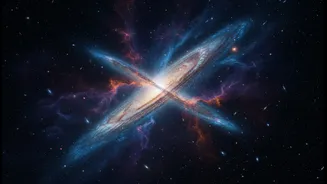
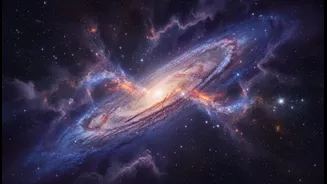
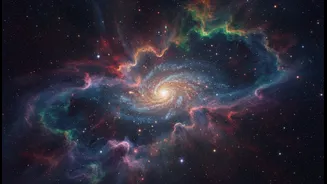
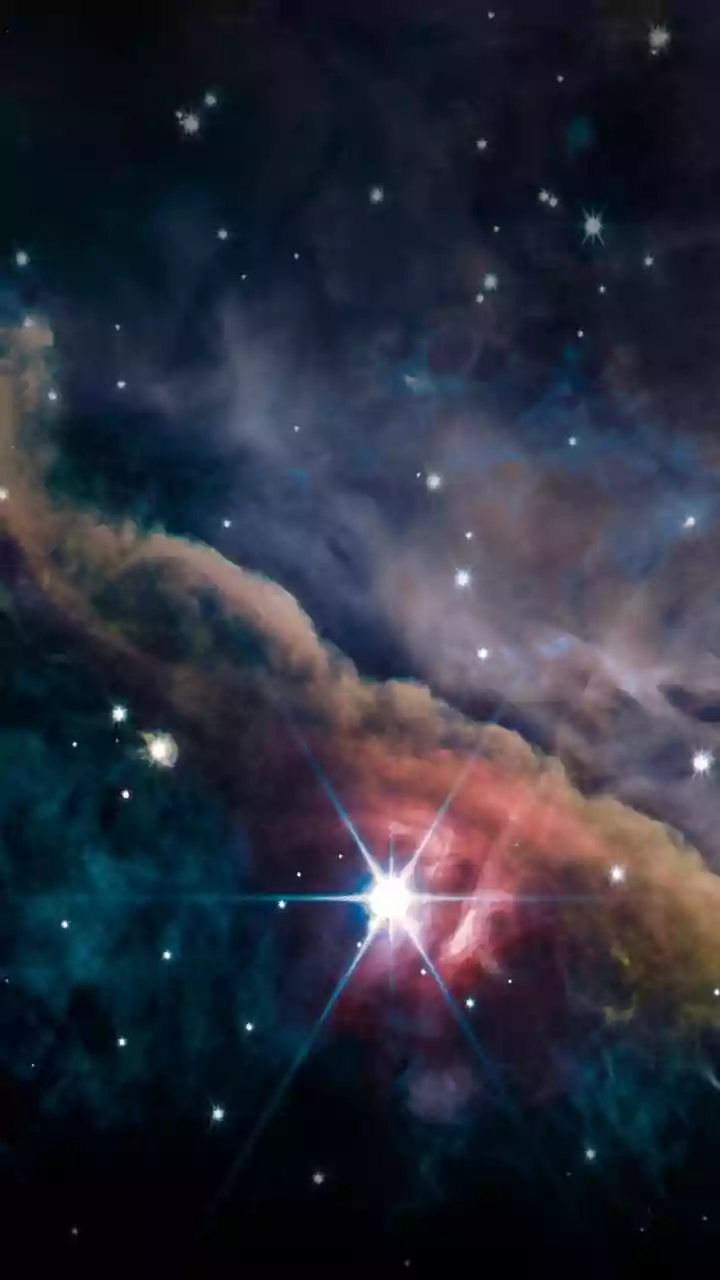
To celebrate its fourth year of science operations, the James Webb Space Telescope (JWST) released an unprecedented view of Centaurus A, a galaxy relatively close to us at 11 million light-years away. Where previous telescopes saw a bright blur obscured
by thick dust, Webb’s infrared eyes peer through the haze to reveal a packed tapestry of millions of individual stars. These images are more than just cosmic art; they are a laboratory for understanding galactic evolution. Centaurus A bears the scars of a collision with another galaxy from about two billion years ago, which left behind a warped disc of gas and dust. At its heart, a supermassive black hole actively feeds on material, launching jets of energy that shape the entire galaxy. By resolving individual stars, astronomers can now piece together the galaxy's history, seeing which stars existed before, during, and after the dramatic merger, making the violent processes that shape our universe feel immediate and real.
Euclid's Grand Map of the Dark Universe
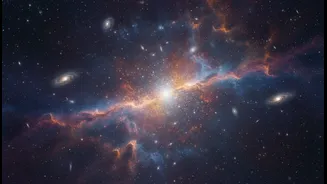
The European Space Agency's Euclid telescope has a monumental task: to map the invisible. Launched in 2023, its mission is to chart the distribution of dark matter and dark energy, which together make up about 95% of the cosmos. While we can't see dark matter directly, Euclid can observe its gravitational effects on the galaxies we can see. By creating the largest-ever 3D map of the universe, observing billions of galaxies up to 10 billion light-years away, Euclid is helping scientists understand the very structure and expansion of everything. In a stunning display of its power, Euclid captured an image of the Milky Way's crowded central hub, resolving over 60 million individual stars in a region so dense it usually appears as a blur. These images provide crucial data that helps make the abstract concepts of dark matter and accelerating expansion feel grounded in observable reality.
A Glimpse into Our Solar System's Future
What happens when a star like our Sun dies? The JWST has provided a fascinating and somewhat unsettling preview. Astronomers pointed Webb at a white dwarf—the hot, dense remnant of a Sun-like star—located 80 light-years away. They were studying a Jupiter-sized planet, WD 1856 b, that orbits this dead star in a scorching-fast 34-hour loop. This planet shouldn't be there; when its star swelled into a red giant, it should have been engulfed and destroyed. Webb's observations not only confirmed the planet's survival but also detected its atmosphere and found it was significantly hotter than expected. By studying this unlikely survivor, scientists are getting their first real look at what the far-future of planets like Jupiter might be, billions of years after our own Sun's death. It’s a powerful reminder that the universe is a place of both destruction and improbable survival.
Hubble's Dazzling Star-Spangled Cluster
Even with newer telescopes on the scene, the Hubble Space Telescope continues to deliver awe-inspiring views of the cosmos. In a recent image celebrating the United States' 250th anniversary, Hubble captured the globular cluster Messier 3 in breathtaking detail. Globular clusters are ancient, tightly packed spheres of stars, and M3 is one of the most impressive, containing over 500,000 stars. Because all the stars in a cluster formed at roughly the same time, they act as cosmic fossils, preserving a record of the early Milky Way's history. This sparkling portrait of red, white, and blue stars isn't just beautiful; it's a treasure trove for astronomers. M3 contains more of a specific type of pulsating star, known as RR Lyrae variables, than any other known cluster in our galaxy, helping scientists piece together the story of how the Milky Way formed and grew over billions of years.