








From Blueprints to Bricks
For the better part of a decade, India laid the legislative and policy groundwork for a fundamental economic shift. Ambitious goals like achieving net-zero emissions by 2070 and generating 500 GW from non-fossil fuel sources by 2030 set the direction.
Foundational policies such as the National Green Hydrogen Mission, various Waste Management Rules, and the Production Linked Incentive (PLI) schemes for batteries and solar modules were designed to create an enabling ecosystem. These frameworks acted as blueprints, signalling the government's intent to move away from a linear 'take-make-dispose' model towards a more sustainable, circular economy. This period was characterized by target-setting, stakeholder consultations, and creating the regulatory certainty needed to attract massive investment.
The New Industrial Landscape
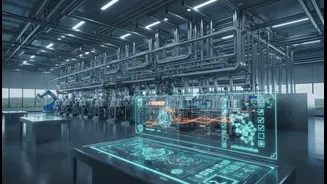
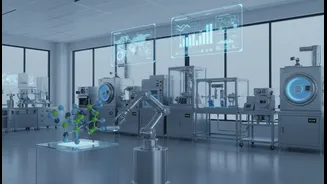
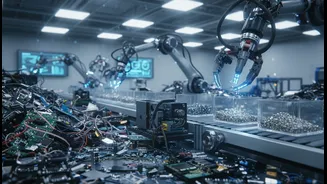
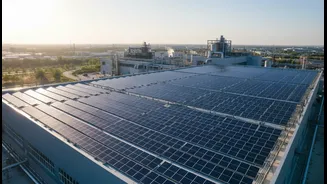
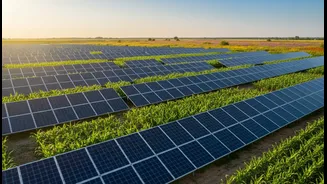
That policy foundation is now supporting a tangible industrial build-out. Across the country, what was once on paper is becoming reality. In Gujarat's Rann of Kutch, the world's largest renewable energy park is taking shape, a testament to India’s solar ambitions. Major corporations are pouring billions into gigafactories for green hydrogen, solar panels, and battery manufacturing. The National Green Hydrogen Mission, with an initial outlay of over ₹19,000 crore, is specifically designed to create production hubs and a robust supply chain. Simultaneously, the circular economy is seeing a surge in activity. Startups are securing significant funding for battery recycling plants, and new rules for managing e-waste, tyres, and construction debris are creating entire new markets for resource recovery. This isn't just about adding renewable capacity; it's about building a sophisticated manufacturing ecosystem for the next generation of clean technology.
A New Generation of Green-Collar Jobs
This industrial shift is creating a seismic change in India's job market. The demand is moving beyond initial installation roles to a new class of 'green-collar' professionals. Projections indicate that the green transition could create millions of jobs in the coming years, with some studies suggesting over six lakh jobs from the Green Hydrogen Mission alone by 2030. Companies are now hiring for roles that barely existed a few years ago: Circular Economy Managers, ESG Analysts, Sustainability Officers, Battery Lifecycle Managers, and Green Finance Specialists. These jobs require a blend of technical expertise, data analysis, policy knowledge, and business strategy. The regulatory push for Extended Producer Responsibility (EPR) and sustainability reporting is making these roles not just desirable, but essential for compliance. As a result, sustainability literacy is fast becoming a core competency for career growth across engineering, finance, and management.
Challenges on the Path to Scale
Despite the momentum, the path to a fully scaled green economy is not without its hurdles. The most significant challenge is a growing skills gap. The demand for experienced professionals in areas like green technology, climate finance, and circularity is outstripping supply. Educational institutions are racing to develop new curricula, but it will take time to build a sufficiently large and trained workforce. Furthermore, scaling these new industries requires immense capital. While government incentives and private investments are flowing, de-risking projects and lowering the cost of capital for early-stage technologies remains a priority. Finally, building out the physical infrastructure, from modernizing the grid to handle renewable energy to establishing efficient waste collection and processing networks, is a long-term undertaking that requires coordinated action between central government, states, and industry.