


The Moon’s Hidden Reservoir
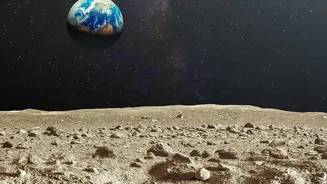
At first glance, the Moon appears to be a barren, airless world. While it lacks a breathable atmosphere, its surface is surprisingly rich in oxygen. The gray dust and crushed rock covering the Moon, known as regolith, is made up of about 45% oxygen by
weight. However, this oxygen isn't free-floating; it's chemically locked away inside minerals as oxides of silicon, iron, aluminum, and magnesium. For decades, scientists have dreamed of breaking those chemical bonds to release this trapped oxygen, a process that would be a game-changer for space exploration. Instead of packing all their air for the trip, future lunar inhabitants could effectively learn to live off the land.
The Science of Brewing Air
So, how do you extract a gas from solid rock? The leading method is a high-temperature process called electrolysis. Think of it as a futuristic, super-powered furnace. First, the lunar regolith is scooped up and heated to extreme temperatures, often above 1,600 degrees Celsius, until it melts into a molten slurry. Sometimes, a molten salt is added to lower the melting point and help electricity flow more easily, in a variation called molten salt electrolysis. An electric current is then passed through the molten material. This jolt of energy is powerful enough to break the strong chemical bonds holding the oxides together. The oxygen atoms, now freed, bubble up and are collected at one electrode, while the remaining molten metals like iron and aluminum pool at the other. In a single stroke, this technique produces not only breathable air but also a stockpile of useful metals.
A New Era of Space Logistics
The ability to manufacture oxygen on-site is a cornerstone of a concept called In-Situ Resource Utilization, or ISRU. ISRU is all about using local materials to reduce the amount of supplies that must be launched from Earth, which is the single biggest constraint on space missions. Every kilogram of cargo sent to the Moon is astronomically expensive. By producing oxygen locally, space agencies like NASA and ESA can dramatically cut down on the mass they need to launch. This allows for longer missions, larger habitats, and more ambitious scientific research. Instead of being limited by the size of their oxygen tanks, astronauts could have a virtually limitless supply, enabling a truly sustainable and long-term presence on the lunar surface.
More Than Just Breathing
The benefits of lunar oxygen extend far beyond life support. One of its most critical applications is as a rocket propellant oxidizer. Most rocket engines work by combining a fuel with an oxidizer to create thrust. Since oxygen is a major component of this mixture, manufacturing it on the Moon could effectively turn our celestial neighbour into a deep-space refueling station. Spacecraft launching from Earth could arrive with just enough fuel to land, then top up their tanks with lunar-made propellant for a return trip or a journey onward to Mars. This model radically alters the economics of space travel, making the solar system more accessible by creating a logistics hub outside of Earth's deep gravity well.
Prototypes and Lingering Hurdles
While the science is sound, building a practical oxygen generator for the Moon presents major engineering challenges. The process is extremely energy-intensive, requiring a powerful and reliable energy source, likely large solar arrays. The machinery must also be able to withstand the Moon's harsh environment, including extreme temperature swings, abrasive dust, and a hard vacuum. Several teams at NASA and ESA, along with private companies like Thales Alenia Space, are actively developing and testing prototype reactors. These prototypes, some the size of a washing machine, are being tested in vacuum chambers on Earth to simulate lunar conditions. The ultimate test, however, will be deploying one of these systems on the Moon itself, a milestone missions are already being planned to achieve within the next decade.