




The Ultimate Sky Lifeboat
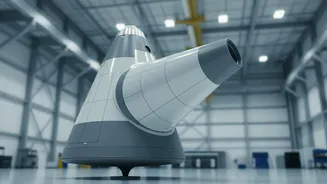
At its core, the Gaganyaan mission requires a foolproof ‘lifeboat’ for its astronauts, formally known as the Crew Escape System (CES). This isn't a component for a normal mission; its only job is to save lives during a launch emergency. Positioned at the very
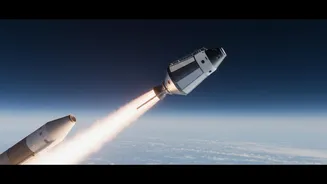
top of the powerful LVM3 rocket, the CES is a collection of quick-acting, high-burn solid motors. If a catastrophic failure is detected during the ascent, the CES is designed to fire with immense force, literally pulling the Crew Module—the capsule containing the astronauts—away from the malfunctioning rocket in milliseconds. The system needs to generate acceleration far greater than the rocket itself to create a safe distance almost instantly.
Simulating Disaster Above the Clouds
While an abort on the launch pad is one scenario, a failure during the atmospheric ascent phase presents a far more complex challenge. This is where high-altitude abort tests, like the Test Vehicle Demonstration 1 (TV-D1) mission, come into play. During this phase, the rocket is travelling at supersonic speeds and experiencing immense structural stress. A high-altitude test simulates a major anomaly under these exact conditions. The test vehicle is launched to a specific altitude and speed—for instance, TV-D1 triggered the abort at an altitude of about 17 km while travelling at Mach 1.2 (1.2 times the speed of sound). This controlled disaster is the only way to prove the escape system works when it matters most.
Anatomy of a Successful Escape
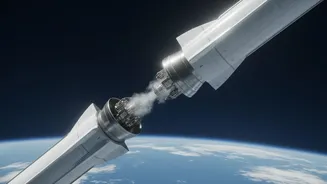
A high-altitude separation test unfolds in a rapid, precisely choreographed sequence. First, an on-board computer system, the Integrated Vehicle Health Management System (IVHM), detects a simulated anomaly and triggers the abort. Instantly, the CES motors fire, pulling the Crew Module clear of the test rocket. Once at a safe distance and altitude, the escape system itself jettisons, and a series of parachutes deploy. Drogue parachutes stabilize and initially slow the capsule, followed by the main parachutes which ensure a gentle splashdown in the sea. Recovery teams are then dispatched to retrieve the capsule, allowing engineers to analyze every piece of data from the flight. The entire sequence, from abort trigger to splashdown, happens in a matter of minutes.
Why This Rigorous Testing is Non-Negotiable
Human spaceflight leaves no room for error, especially when it comes to safety systems. These separation tests are not just about seeing if a parachute opens. They validate the entire life-saving chain of events under realistic conditions. Engineers collect crucial data on the performance of the escape motors, the aerodynamic stability of the capsule as it's pulled away, the precise timing of the parachute deployment, and the structural integrity of the Crew Module. The Gaganyaan rocket uses powerful solid-fuel boosters that, once ignited, cannot be shut down. This makes an escape system the only option in case of a problem during early ascent, underscoring why these validation tests are absolutely critical before putting human lives on the line.
Building Confidence, One Test at a Time
The high-altitude abort demonstrations are part of a larger, methodical testing campaign to ensure the Gaganyaan system is as safe as humanly possible. These build on the success of earlier trials, such as the Pad Abort Test in 2018, which validated the escape system's ability to function from a standstill on the launchpad. Each successful test, from verifying parachute systems to ensuring the capsule can right itself after splashdown, adds another layer of confidence. By systematically simulating and overcoming worst-case scenarios, ISRO is not just building a spacecraft; it is forging a reliable lifeline for India's future Gaganauts, proving the systems are ready for the ultimate journey.