
For decades, we’ve known the universe is 13.8 billion years old. But a radical new theory suggests it might be twice that age, clocking in at 26.7 billion years. This idea aims to solve a major cosmic puzzle, but it faces an uphill battle against decades of
established science.
The 'Impossible' Galaxy Problem
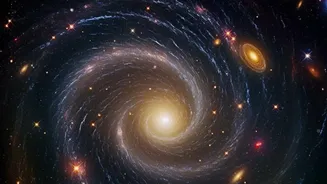
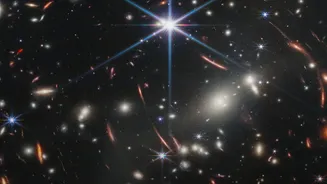
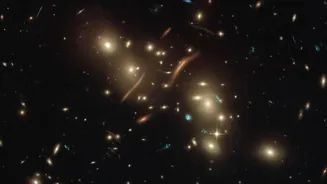
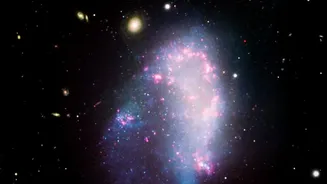
The controversy began with stunning images from the James Webb Space Telescope (JWST). Peering into the dawn of time, JWST spotted galaxies that were surprisingly massive, structured, and mature. According to the standard model of cosmology, called Lambda-CDM, these galaxies existed when the universe was just a few hundred million years old. This created a headache for astrophysicists: how could such complex galaxies form so quickly after the Big Bang? It was like finding a fully grown adult in a nursery, challenging fundamental assumptions about how long cosmic evolution should take. This puzzle is often called the 'impossible early galaxy problem'.
A Universe Twice as Old?
Enter University of Ottawa adjunct professor Rajendra Gupta. To solve the puzzle, he proposed a dramatic solution: maybe the universe has had much more time to evolve. His model, known as CCC+TL (Covarying Coupling Constants plus Tired Light), calculates the age of the universe to be 26.7 billion years. In this expanded timeline, the 'impossible' early galaxies are no longer so impossible. Instead of forming in a cosmic sprint just 300 million years after the Big Bang, they would have had billions of years to grow and mature into the structures JWST now sees. According to Gupta, this simple shift makes 'impossible early galaxies become predictable galaxies'.
Reviving a 'Tired Light' Idea
To achieve this older age, Gupta's model resurrects a century-old, controversial idea called 'tired light'. First proposed by Fritz Zwicky in 1929, this theory suggests that the redshift of distant galaxies—the stretching of light to longer, redder wavelengths—isn't just caused by the expansion of space. It posits that photons of light also naturally lose energy as they travel over billions of light-years, making them appear redder. Gupta's model combines this tired light concept with another idea: that the fundamental forces of nature, known as 'coupling constants', might change over cosmic time. Together, these two mechanisms would reinterpret redshift measurements, stretching the universe's timeline significantly.
Why Most Scientists Are Skeptical
While intriguing, the CCC+TL model faces major hurdles. The 'tired light' hypothesis has been tested and largely rejected by the scientific community for decades. Mainstream cosmology has shown that a simple tired light model fails to explain several key cosmic observations. For one, it would cause the light from distant objects to appear blurry, which is not what we see. More importantly, it is inconsistent with observations of the Cosmic Microwave Background (the Big Bang's afterglow) and the time dilation seen in distant supernovae. While Gupta's model is more complex than the original tired light theory, it inherits the deep skepticism attached to its core idea. The standard Lambda-CDM model, which puts the universe's age at 13.8 billion years, successfully explains a vast range of observations, from the afterglow of the Big Bang to the large-scale structure of the cosmos.
Science at a Crossroads
The scientific process thrives on challenges like this. The 'impossible' galaxies seen by JWST present a genuine puzzle that requires an explanation. For most cosmologists, the answer likely lies in refining our understanding of galaxy formation, not in overthrowing the entire standard model. Perhaps early galaxies formed more efficiently than our simulations predicted, or maybe they contain more mass in faint, low-mass stars than previously estimated. Gupta's model offers a more radical alternative, and he argues it holds up against several cosmological tests. However, it remains a fringe concept, and convincing the broader scientific community will require extraordinary evidence that can stand up against the mountain of data supporting the 13.8 billion-year-old universe.