

For decades, we've understood the universe to be about 13.8 billion years old. But what if it's actually twice that age? A new scientific model proposes just that, suggesting our cosmos is a staggering 26.7 billion years old. Here’s the story.
The Established Cosmic Age
The long-accepted
age of the universe, 13.8 billion years, is a cornerstone of modern cosmology. This figure comes from the Standard Model of cosmology, often called the Lambda-CDM model. Scientists arrived at this number by measuring the expansion of the universe and tracing it backward in time to a single point of origin—the Big Bang. Evidence for this model is vast, including the faint, all-sky glow of the cosmic microwave background (CMB), which is the leftover heat from the Big Bang, and the observed distribution of galaxies. For decades, this model has successfully explained most of what we see in the cosmos, providing a reliable framework for our place in cosmic history.
A Wrinkle in Time
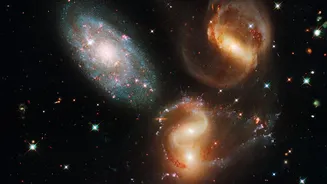
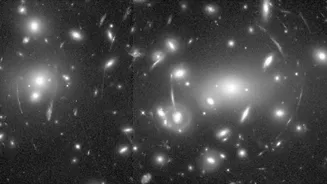
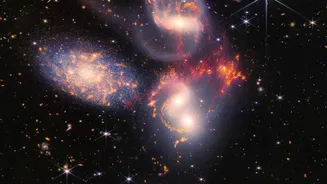
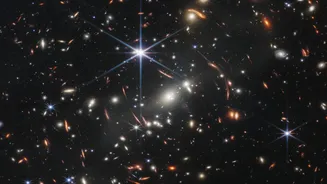
Recently, however, observations from the James Webb Space Telescope (JWST) have presented a puzzle. The powerful telescope has spotted galaxies in the very early universe that appear far too massive and mature. According to the standard 13.8-billion-year timeline, these 'impossible early galaxies' shouldn't have had enough time to grow so large. This cosmic conundrum prompted Rajendra Gupta, a physics professor at the University of Ottawa, to propose a new model. In a study published in a leading astrophysics journal, he suggests a new age for the universe: 26.7 billion years. This extended timeline, he argues, could easily allow for the formation of such advanced early galaxies.
Redefining Cosmic Rules
To nearly double the age of the universe, Gupta’s model dusts off and revamps an old theory known as 'tired light'. First proposed about a century ago by Fritz Zwicky, this idea suggests that light loses energy as it travels across vast cosmic distances, causing its wavelength to stretch and appear redder. This 'redshift' is usually attributed to the expansion of the universe. The tired light theory was largely set aside because it couldn't explain many key cosmic observations. Gupta's model is a hybrid. It combines a version of tired light with another complex idea: that the fundamental forces of nature, known as 'coupling constants', might themselves evolve over time. By blending these two concepts with the standard model, he calculates a much older cosmos.
A Universe of Possibilities
If this new model were correct, the implications would be profound. An extra 13 billion years of cosmic history would change our understanding of everything from galaxy formation to the lifecycle of the earliest stars. Events we thought happened in a cosmic hurry, like the formation of the first supermassive black holes, would have had a much longer and more leisurely timeline to unfold. It would fundamentally redraw our map of the universe's past, present, and future. However, it’s crucial to understand that this is, for now, a single theoretical proposal. It stands in opposition to a mountain of evidence supporting the standard 13.8-billion-year model.
Science in Motion
Gupta's model is an example of the scientific process in action. A new observation (the 'impossible' galaxies) challenges the existing theory, and a scientist proposes a new hypothesis to explain it. Now, the real work begins. For this new idea to gain traction, it must do more than just solve one puzzle. It must also be able to explain all the other things the standard model gets right, from the cosmic microwave background to the abundance of light elements in the universe. The scientific community will now rigorously test this model, scrutinise its assumptions, and see if it holds up. This process of challenge, verification, and debate is how our understanding of the universe deepens.