





First, What Is a Quasar?
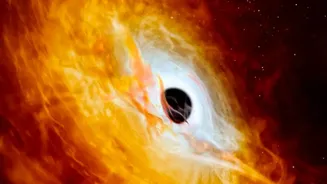
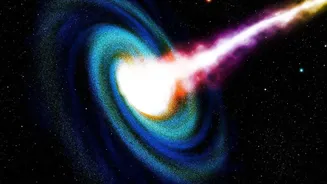
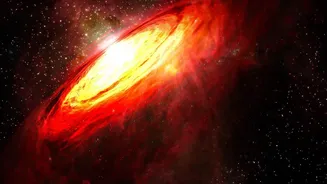
A quasar, short for 'quasi-stellar radio source', is one of the most luminous and energetic objects in the universe. At the heart of a distant galaxy, a supermassive black hole furiously consumes surrounding gas and dust. This material forms a spinning
disc around the black hole, and the intense gravitational forces and friction heat it to millions of degrees, causing it to glow with unimaginable brightness—often outshining all the stars in its own galaxy combined. Because they are so bright, quasars act as cosmic lighthouses, allowing astronomers to study the conditions of the very early universe. When we observe a quasar billions of light-years away, we are seeing it as it was billions of years ago.
A Record-Breaking Discovery
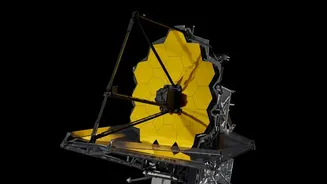
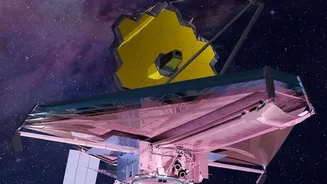
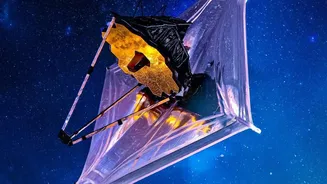
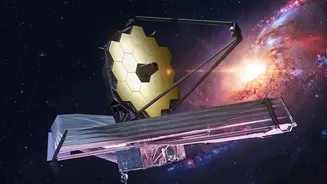
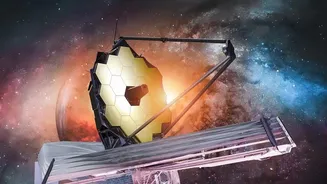
Using data from the JWST and the Gemini North telescope, astronomers have identified the oldest and most distant pair of quasars ever seen. Nicknamed Nāpōwawāʻenakaulua, the system was spotted as it existed just 900 million years after the Big Bang. This period is known as the 'cosmic dawn', when the first stars and galaxies were forming. The discovery is stunning because current theories struggle to explain how such massive black holes—one is 1.5 billion times the mass of the sun, the other 400 million—could have grown so enormous, so quickly. Finding one is a puzzle, but finding a pair this early challenges our understanding of cosmic evolution.
Why a Pair Is So Important
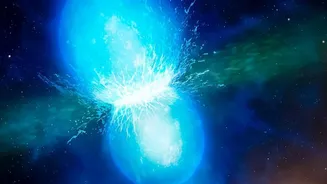
Observing a pair of quasars is more significant than finding a single one. This discovery is a snapshot of a massive cosmic event in progress: a galaxy merger. In the early universe, galaxies frequently collided and merged. These mergers are believed to be a primary driver of galaxy growth, funnelling huge amounts of gas toward the central black holes and igniting them as quasars. The Nāpōwawāʻenakaulua pair are relatively close, separated by only 18,100 light-years, suggesting they are on a collision course. This gives scientists a real-world laboratory to study how the first massive galaxies and their black holes assembled themselves during this chaotic, formative era.
Cosmic Beacons, Not Nearby Threats
The immense power of a quasar can be intimidating. If one were as close as Pluto, its radiation could be devastating. However, the headline's mention of 'nearby danger' is a complete misinterpretation of this discovery. These quasars pose absolutely no threat to Earth. They are located billions of light-years away, meaning the light we see today left them when the universe was in its infancy, long before our solar system even existed. There are no quasars near our Milky Way galaxy; they are a feature of the ancient, distant universe. The very power that could make them dangerous up close is what makes them invaluable to science, allowing them to be seen across such vast cosmic distances. They are a window to the past, not a warning about our future.