




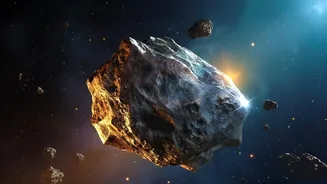
The Great Cosmic Search
The process begins with a monumental search. Astronomers don't just point telescopes randomly; they use powerful, wide-field survey telescopes that scan enormous sections of the sky every single night. Projects like the Pan-STARRS in Hawaii and the forthcoming
Vera C. Rubin Observatory in Chile are designed to do exactly this. Their software compares images of the same patch of sky taken minutes or hours apart. Stars and galaxies remain fixed, but an asteroid, comet, or something else moving through our solar system will appear as a faint dot that has shifted its position. This automated process flags thousands of potential moving objects, creating a nightly list of candidates for astronomers to investigate. Even amateur astronomers can join the hunt through citizen science projects, sifting through telescope data to find the next discovery.
Connecting the Dots
Finding a single moving dot isn't enough. To understand what it is and where it's going, astronomers need to play connect-the-dots on a cosmic scale. This is the crucial step of orbit determination. After a new object is flagged, telescopes around the world are alerted to make follow-up observations. By gathering several measurements of the object's position over hours and days, scientists can calculate its trajectory. They determine key parameters like its speed and the shape of its orbit—whether it's a near-circular path like a planet's or a highly stretched-out ellipse typical of comets. This data is sent to a global clearinghouse, the Minor Planet Center, which confirms if the object is genuinely new and publishes its orbital path for all astronomers to see.
What Are We Looking At?
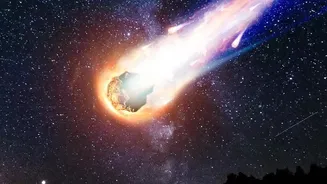
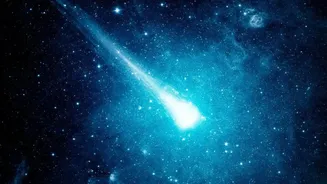
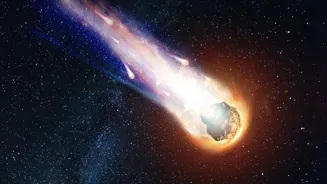
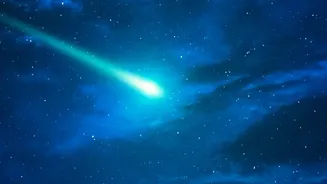
Once an orbit is known, classification begins. The shape of the orbit itself provides major clues. If the object follows an elliptical path around our Sun, it's likely a familiar neighbour like an asteroid or a comet. However, if its path is a hyperbola—an open-ended trajectory showing it's moving too fast to be trapped by the Sun's gravity—then astronomers know they have found something truly special: an interstellar object. These are visitors from another star system, like the famous 'Oumuamua and 2I/Borisov. The object's appearance also matters. If it develops a fuzzy halo (a coma) or a tail as it nears the Sun, it's classified as a comet, as ice on its surface turns to gas. If it remains a stark point of light, it's likely a rocky asteroid.
Decoding a Chemical Barcode
To learn what a mysterious object is made of, astronomers become cosmic detectives, analysing the light it reflects. This technique is called spectroscopy. Sunlight bounces off the object's surface, and different minerals absorb specific colours, or wavelengths, of light. By passing the reflected light through an instrument called a spectrograph, scientists can see which colours are missing. These missing bands act like a unique chemical barcode, revealing if the surface is rich in iron, stony silicates, or the carbon compounds and water-bearing clays found on primitive asteroids. This helps them understand the object's origin and history, all from millions of kilometres away.
Getting a Closer Look
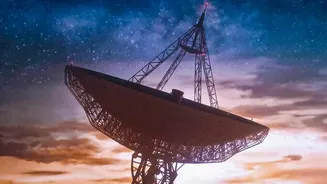
While telescopes tell us a lot, some techniques offer a more detailed picture. Planetary radar, for example, involves beaming powerful microwave signals at a nearby object and analysing the returning echo. The way the signal scatters reveals the object's size, shape, rotation speed, and whether it's a solid chunk of rock or a loose collection of rubble. For the most definitive answers, nothing beats a direct visit. Missions like NASA's OSIRIS-REx, which returned samples from the asteroid Bennu, allow scientists to analyse pristine material in labs on Earth. These up-close encounters provide ground truth, confirming and enriching the discoveries made from afar.