

What Are Ice Cores Anyway?
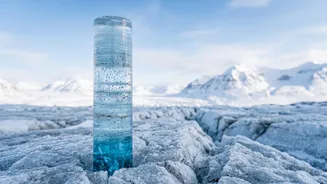
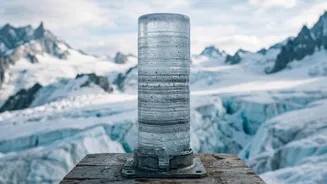
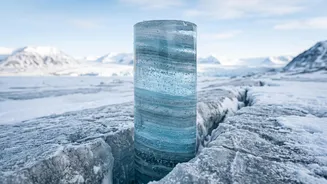
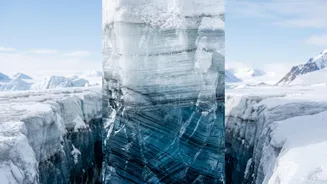
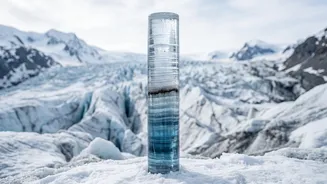
Imagine a library where the books are made of ice and the words are trapped air bubbles, dust, and chemicals. That’s essentially what an ice core is. Scientists drill deep into glaciers and ice sheets in places like Antarctica or Greenland, extracting
long cylinders of ice. Each year, new layers of snow fall and compact the older layers, creating a vertical timeline of Earth's history that can stretch back hundreds of thousands of years. These cores provide direct evidence of past temperatures, atmospheric composition, and major environmental events, making them invaluable for understanding climate change.
Volcanic Eruptions as Nature’s Timestamps
One of the most reliable ways to mark time in an ice core is to find evidence of massive volcanic eruptions. When a volcano erupts explosively, it spews ash and sulfur-rich gases high into the atmosphere, which then spread around the globe. This material eventually settles back to Earth, including on the vast ice sheets of the polar regions. This leaves a distinct chemical layer—a spike in sulfate or visible particles of ash (tephra)—trapped in the ice for a specific year. Because the dates of major historical eruptions, like the 1815 eruption of Mount Tambora, are well known, scientists can scan the core for that specific chemical signature and anchor that point in their timeline. This is known as a volcanic horizon marker.
Matching the Chemical Fingerprint
Not all volcanic layers are from famous, historically documented eruptions. Sometimes scientists find a layer of tephra (volcanic ash) from an unknown event. In these cases, they perform a chemical analysis on the tiny glass shards within the ash. Every eruption has a unique chemical 'fingerprint' based on the magma it came from. By matching this fingerprint to geological samples from volcanoes around the world, researchers can often identify the exact source and, if that eruption has been dated elsewhere, apply that date to the ice core. This technique, called tephrochronology, allows scientists to connect and synchronise climate records from different parts of the world with incredible precision.
The Atomic Clock: Radiometric Dating
While volcanic markers are like bookmarks, radiometric methods provide a way to calculate the age of the material itself. This technique relies on the predictable decay of radioactive isotopes—unstable atoms that transform into stable ones over a fixed period. The 'half-life' of an isotope is the time it takes for half of a given sample to decay. By measuring the ratio of the original 'parent' isotope to the stable 'daughter' isotope, scientists can calculate how long it has been since the material was formed or trapped.
Dating the Trapped Air
You can't directly radiocarbon date the ice itself, as it contains no carbon. However, the air bubbles trapped within the ice are a different story. These bubbles are tiny, pristine samples of ancient atmosphere, complete with carbon dioxide. Scientists can carefully extract this air and use Carbon-14 dating on the CO2. Carbon-14 has a half-life of about 5,730 years, making it effective for dating ice up to around 50,000 years old. For older ice, scientists may turn to other isotopes trapped in dust, like Beryllium-10 or the ratio of Chlorine-36 to Beryllium-10, which have much longer half-lives.
Combining Methods for Ultimate Accuracy
No single dating method is perfect. The most accurate ice core chronologies are built by combining multiple techniques. Scientists might count the visible annual layers as far down as they can, then use a volcanic marker to confirm a date thousands of years ago. They can then use radiometric dating on trapped air bubbles from that same section to cross-check the age. Computer models of how ice flows and compacts under pressure also help refine the age-depth relationship, especially in the oldest, most compressed parts of the core. By using these methods together, scientists can confidently read the stories locked within the ice and reconstruct our planet’s climate history with remarkable detail.