


A New Star Challenges Old Beliefs
For centuries, Western thought was dominated by the Aristotelian view of the cosmos: a perfect and unchanging celestial realm far above an imperfect Earth. Events like comets were considered atmospheric phenomena, not part of the heavens. But the appearance
of Supernova 1604, along with Tycho Brahe's supernova just 32 years earlier, presented a direct challenge to this doctrine. Astronomers across Europe observed the 'stella nova', or new star, and meticulous measurements showed it had no discernible parallax, meaning it was located far beyond the Moon, in the supposedly immutable sphere of the fixed stars. This inconvenient fact provided powerful evidence that the heavens were, in fact, dynamic and subject to change, helping to dismantle a worldview that had stood for millennia.
Kepler's Meticulous Observations
While many observed the new star, it is German astronomer Johannes Kepler whose name became inextricably linked with it. He began his detailed study on October 17, 1604, and tracked the object for over a year until it faded from naked-eye view. In his 1606 book, 'De Stella Nova in Pede Serpentarii' (On the New Star in the Foot of the Serpent Handler), Kepler not only documented the star's position with remarkable accuracy but also recorded its changing brightness over time, creating an early version of what astronomers now call a light curve. His systematic approach, undertaken entirely without the aid of a telescope which had not yet been pointed to the sky, laid a foundation for the rigorous, evidence-based inquiry that defines modern science.
The Modern Diagnosis: A Type Ia Explosion
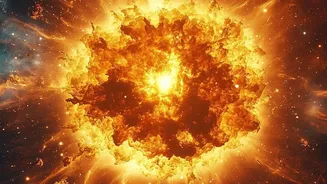
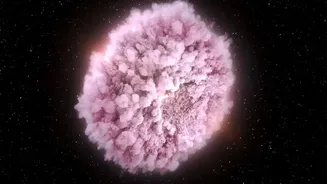
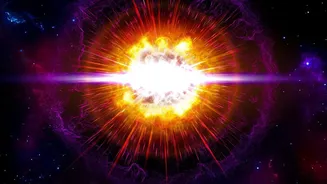
What Kepler and his contemporaries saw as the birth of a star, modern astronomers understand as a star's violent death. SN 1604 is now classified as a Type Ia supernova. This specific type of cataclysm occurs in a binary star system when a white dwarf—the dense, dead core of a star like our Sun—accretes matter from a companion star. Once the white dwarf's mass exceeds a critical limit, it triggers a runaway thermonuclear explosion that obliterates the star. This understanding is the result of centuries of scientific progress, but it also provides a key to one of the supernova's most profound legacies.
A Cosmic Measuring Stick
The most significant aspect of SN 1604's legacy is its classification as a Type Ia supernova. Because these explosions always happen at roughly the same mass limit, their peak brightness is incredibly consistent. This makes them invaluable tools for cosmologists, who use them as 'standard candles' to measure vast distances across the universe. By comparing the known intrinsic brightness of a Type Ia supernova with how dim it appears from Earth, astronomers can calculate its distance with remarkable precision. This very method led to the groundbreaking discovery that the expansion of the universe is accelerating, a finding that earned a Nobel Prize and introduced the concept of dark energy. The 1604 event, though not used for these measurements itself, is a nearby prototype of the cosmic yardsticks that unlocked this fundamental secret of the universe.
The Remnant's Enduring Secrets
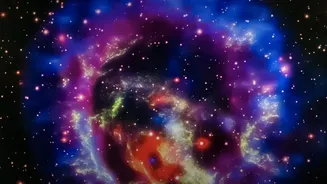
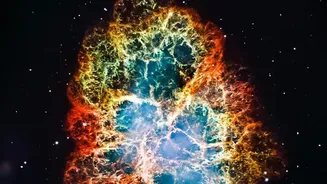
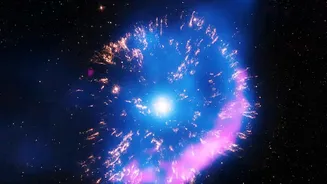
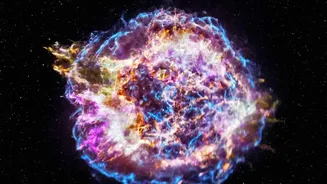
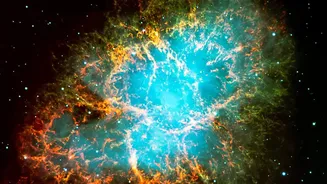
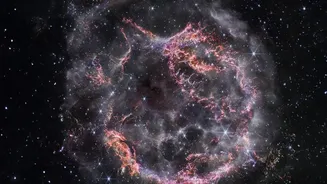
Though the star itself is long gone, its story isn't over. The expanding cloud of gas and dust left behind, known as Kepler's Supernova Remnant, is still a vibrant subject of astronomical study. Modern observatories like NASA's Chandra X-ray Observatory and the Spitzer Space Telescope have captured stunning images of this remnant, located about 20,000 light-years away. These images reveal material heated to millions of degrees, blasting outward at speeds up to 2% of the speed of light. By studying the shape, speed, and chemical composition of this debris field, scientists can piece together clues about the moments leading up to the explosion and the nature of the star system that was destroyed, continuing the scientific inquiry that Kepler himself began over four centuries ago.