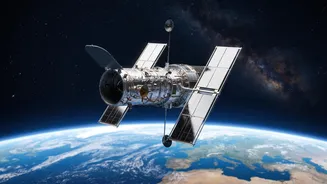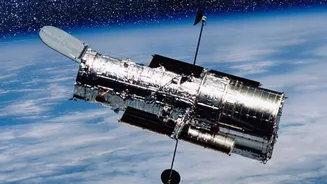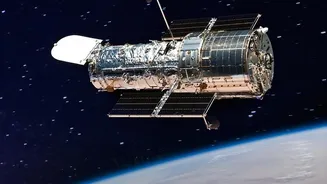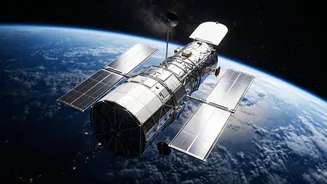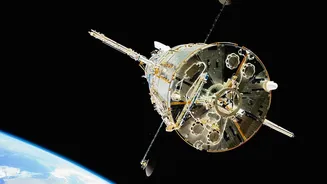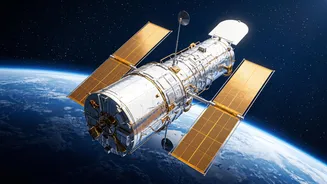



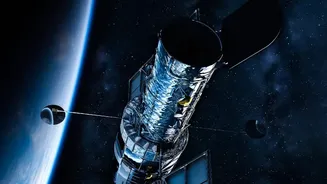
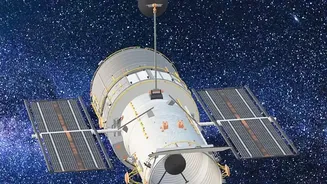
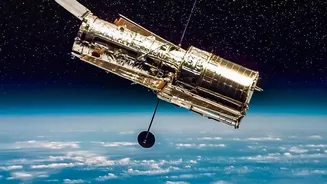
For over three decades, the Hubble Space Telescope has been humanity's eye on the cosmos. Now, its legendary watch could be coming to an end. As its orbit slowly decays, NASA is turning to private industry for a potential rescue.
An Icon's Slow Descent
The Hubble Space Telescope
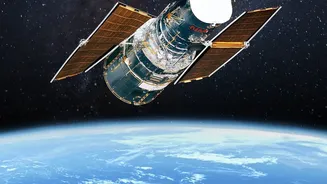
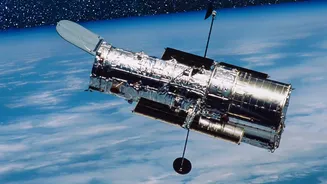
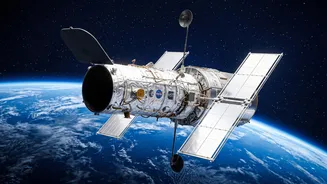
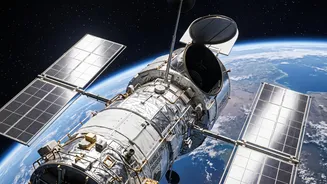
is not failing; it is falling. Launched in 1990, the observatory operates in low-Earth orbit where the faint traces of our atmosphere create a constant drag, slowly pulling it downward. Unlike modern satellites, Hubble has no onboard propulsion system to push itself back up. Its altitude has already dropped significantly from its last boost by a space shuttle mission. Current projections estimate that without intervention, the telescope will re-enter Earth's atmosphere and burn up sometime between 2033 and 2034. This gradual orbital decay threatens to prematurely end the mission of one of the most productive scientific instruments ever built, one that is still in high demand by astronomers worldwide.
NASA's Call for Commercial Ideas
Recognizing the urgency, NASA has formally issued a 'Request for Information' (RFI), asking the commercial space sector to present their ideas for a support mission. This is not yet a contract but a crucial first step to survey the market and understand what is technologically and financially feasible. The RFI outlines three potential mission profiles: capture Hubble and boost it to a higher, more stable orbit of at least 600 kilometers; perform a servicing mission to enhance its capabilities; or, as a final option, guide the telescope to a safe, controlled de-orbit over an uninhabited stretch of ocean. Companies have until November 30 to submit their concepts, which must demonstrate a mission could be carried out by 2032 without harming the priceless observatory.
Who Could Save Hubble?
This isn't the first time a private rescue has been discussed. In 2022, a study was conducted with SpaceX and the Polaris Program, funded by entrepreneur Jared Isaacman, to explore using a Crew Dragon capsule for a reboost. Though NASA decided not to proceed at that time, the landscape has changed. Isaacman is now NASA's administrator, and the new RFI signals a renewed interest in a commercial solution. The mission would be entirely handled by the chosen company, which would be responsible for the launch vehicle, the servicing spacecraft, and all mission operations. While a crewed mission remains a possibility, many expect proposals to focus on advanced robotic servicers, a technology field that has matured significantly in recent years.
High Risk, High Reward
Any attempt to dock with Hubble is fraught with risk. The telescope was designed to be serviced by astronauts using the space shuttle's robotic arm, not to be captured by a new generation of robotic or crewed vehicles. A miscalculation during the rendezvous and capture could potentially damage or even destroy the telescope. The recent failure of a commercial mission intended to reboost the smaller Swift observatory serves as a stark reminder of the challenges of in-orbit servicing. However, the potential reward is immense. A successful boost could extend Hubble’s life by another two decades or more, allowing it to continue its groundbreaking science and work alongside newer observatories like the James Webb Space Telescope.
Pioneering a New Space Economy
The mission to save Hubble is about more than just one telescope. A successful commercial servicing mission would mark a pivotal moment for the space industry, proving the viability of a new market for extending the lives of valuable satellites. This could change the way satellites are designed and managed, creating a future where refueling, repairing, and upgrading assets in orbit is a routine commercial service. As Nicky Fox, NASA's associate administrator for science, noted, the commercial industry has evolved rapidly, offering new capabilities for in-space capture and servicing. This effort could serve as a trailblazing demonstration, paving the way for a more sustainable and dynamic economy in low Earth orbit.