




What Am I Looking For?
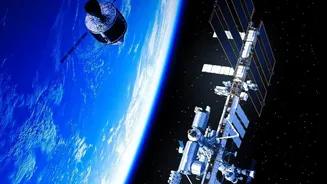
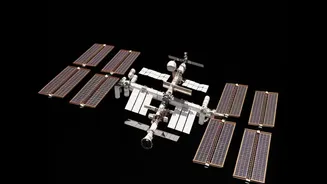
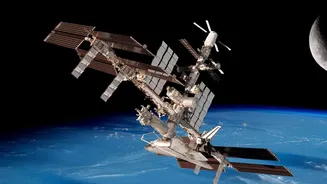
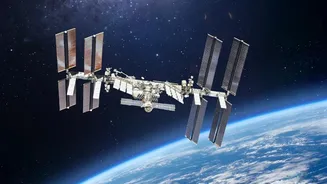
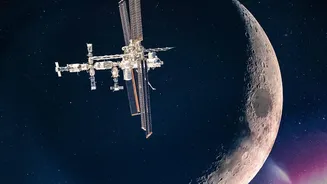
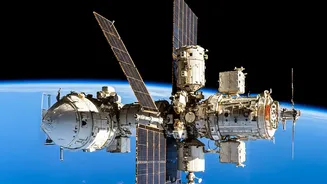
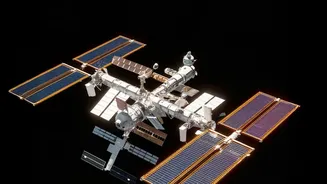
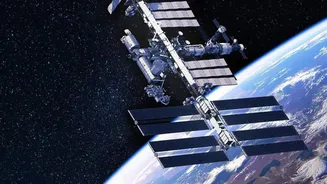
Forget what you see in movies. To the naked eye, the International Space Station doesn’t look like a complex structure. Instead, it appears as a very bright, fast-moving point of light, almost like a star gliding smoothly across the sky. Unlike an aeroplane,
the ISS does not have flashing or blinking lights. It moves much faster than a plane and will cross your entire field of view in just a few minutes. It shines because its massive solar panels reflect sunlight, making it one of the brightest objects in the night sky, outshone only by the Sun and the Moon. Its brightness allows it to be seen even from light-polluted urban centres.
The Golden Hours for Sighting
You can’t just look up at any time of night and expect to see the station. The magic window for spotting the ISS is typically in the hours just after sunset or before sunrise. This is the perfect time because your location on the ground is dark, but the ISS, at its high altitude of over 400 kilometres, is still illuminated by the Sun. During the middle of the day, the sky is too bright to see it, and in the middle of the night, the station is often in Earth's shadow and therefore not reflecting any light. These dawn and dusk passes provide the ideal contrast for a clear view.
How to Find Timings for Your City
This is the most crucial step. Since the ISS orbits the Earth about 16 times a day, its path over India changes constantly. You need precise timings for your specific location. The best and most official tool is NASA's 'Spot The Station' website. You can simply select India and then choose your nearest city from the list—from Ahmedabad to Lucknow to Mumbai—to get a schedule of upcoming viewing opportunities. The schedule will tell you the exact time the sighting will start, how long it will last, the maximum height it will reach in the sky, and the direction to look (e.g., 'Appears: WSW, Disappears: NE'). For those who prefer apps, several reliable options like ISS Detector, Heavens-Above, and Satellite Tracker can send you notifications right before a pass is about to happen.
A Simple Viewing Guide
Once you have your city's pass time, spotting it is simple. First, check the weather; clear skies are essential. About 15 minutes before the scheduled time, go outside to a spot with a relatively unobstructed view of the sky, especially in the direction the station is set to appear. An open field, a rooftop, or a balcony can work well. Give your eyes a few minutes to adjust to the darkness—avoid looking at your bright phone screen. At the designated time, start scanning the sky in the direction mentioned by the tracking tool. For instance, if the alert says it will appear in the southwest, face that way and look for a new 'star' that is steadily on the move. Then, just watch as this marvel of engineering silently soars overhead.
A Moment of Awe
As you watch that point of light, take a moment to consider what you're seeing. The ISS is a home and workplace for astronauts from around the world, travelling at a staggering speed of nearly 28,000 kilometres per hour. For the few minutes it is in your sight, you are connecting with one of humanity's greatest achievements in science and collaboration. India's geographical location provides some of the best and most frequent opportunities in the world to see the station, often passing directly overhead. It’s a powerful reminder of what is possible and a fantastic way to feel connected to the larger universe, all from the comfort of your own city.