






The Twin Crises: Bleaching Reefs and Declining Fish
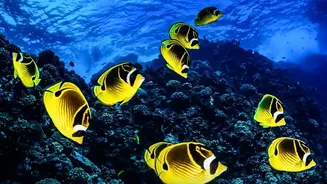
Coral reefs are not just beautiful underwater structures; they are bustling cities that support approximately 25% of all marine life. In India, the reefs in the Gulf of Mannar, Gulf of Kutch, Andaman and Nicobar and Lakshadweep islands are critical ecosystems.
However, rising ocean temperatures due to climate change are causing a devastating phenomenon known as coral bleaching. When waters get too warm, corals expel the symbiotic algae living in their tissues, causing them to turn white and starve. Major bleaching events in 1998, 2010, and 2016 severely impacted India's reefs. This isn't just an environmental tragedy. The loss of coral has a direct and severe impact on coastal fisheries. Healthy reefs provide shelter, food, and breeding grounds for countless fish species. When the reefs die, fish populations plummet, threatening the livelihoods of millions who depend on the sea.
A Glimmer of Hope: Assisted Evolution
In the face of this challenge, scientists are exploring a groundbreaking field called 'assisted evolution'. This is not about creating genetically modified organisms in a lab, but rather about accelerating naturally occurring processes to help corals adapt faster than they could on their own. The goal is to identify and propagate corals that are naturally more resilient to heat stress—often called 'super corals'. These are corals that, for reasons scientists are eagerly studying, have shown a remarkable ability to survive or recover from bleaching events that kill their neighbours. By understanding what makes these corals special, researchers hope to give entire reef systems a fighting chance.
Breeding 'Super Corals'
The process of breeding heat-tolerant corals involves several innovative techniques. One key method is selective breeding. Scientists identify and collect samples from adult corals that have proven their resilience during a heatwave. During the annual spawning events, they cross-breed these tough individuals, hoping to produce offspring that inherit this heat tolerance. Studies have shown that even in a single generation, it is possible to produce offspring with a measurably higher tolerance to heat. Another technique involves conditioning corals by gradually exposing them to warmer water in controlled environments, which can sometimes boost their resilience and that of their offspring. The aim is to create a stock of tougher corals that can be used in restoration projects.
The Crucial Link to Fisheries
The connection between this high-tech science and the daily catch of a fisherman is direct and powerful. Restoring coral reefs means restoring fish habitats. A two-decade-long coral restoration project in India's Gulf of Mannar provided stunning proof of this. Researchers found that as live coral cover increased sevenfold in restored areas, the density of fish soared by an incredible 21 times over the same period. In another project at Mithapur in Gujarat, the amount of fish caught by fishermen surged tenfold after restoration efforts. By planting hardier, heat-tolerant corals, we are not just saving an ecosystem; we are rebuilding the natural infrastructure that sustains coastal fisheries and, by extension, supports the food security and economic stability of coastal communities.
Not a Magic Bullet, But a Vital Tool
It is crucial to understand that breeding 'super corals' is not a cure-all solution. Experts caution that this approach is no substitute for aggressive global action to reduce greenhouse gas emissions and halt climate change, which is the root cause of the problem. Coral breeding and restoration are complex, expensive, and currently can only be done at a relatively small scale compared to the vastness of ocean reefs. Furthermore, the heat tolerance gained through breeding is still modest compared to the projected increases in ocean temperatures if warming continues unchecked. However, it represents a vital tool in a broader conservation strategy. It provides a way to bolster the resilience of the most critical reef areas, buying them precious time and helping to preserve genetic diversity.