


The Next Frontier: From Landing to Returning
Successfully landing a craft on the Moon is a monumental achievement, but bringing samples back is an entirely different level of complexity. To date, only the United States, the former Soviet Union, and China have accomplished this feat. Each of these
missions provided invaluable scientific data, but they were limited to specific regions of the Moon. Chandrayaan-4 aims to join this exclusive club with an unprecedented level of technological sophistication. The goal isn't just to retrieve lunar soil, or regolith, but to demonstrate a suite of advanced capabilities that will pave the way for future crewed missions, including India's goal of landing an astronaut on the Moon by 2040.
A Complex Five-Module Architecture
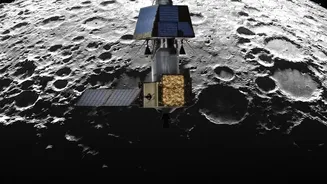
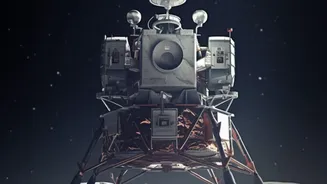
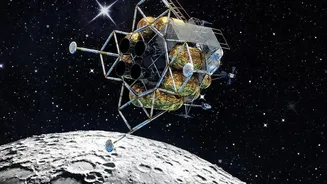
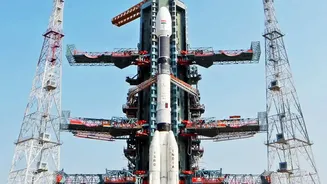
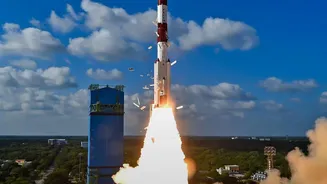
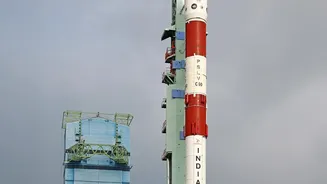
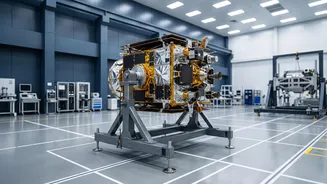
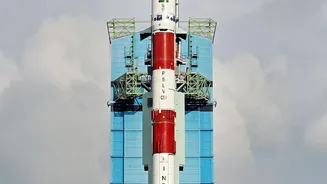
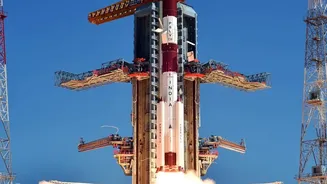
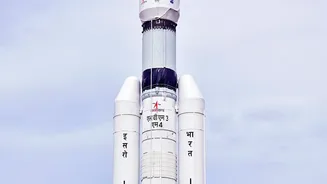
At the heart of Chandrayaan-4's innovation is its sheer complexity. The mission will use five separate spacecraft modules: a Propulsion Module, a Descender Module (lander), an Ascender Module, a Transfer Module, and a Re-entry Module. Because the combined weight of these components is too heavy for a single launch, ISRO will use two of its most powerful LVM3 rockets. The two stacks will be launched separately and then perform a docking manoeuvre in Earth's orbit—a critical capability ISRO is developing—before proceeding to the Moon as a single integrated spacecraft.
The Robotic ‘Hand-Off’ in Deep Space
Once in lunar orbit, the mission's intricate dance begins. The lander and ascender will separate and touch down on the lunar surface. There, a robotic arm will scoop up surface samples while a drilling mechanism will collect material from below the surface—a two-pronged approach to gathering diverse geological specimens. These samples, weighing up to 3 kilograms, will be transferred to the Ascender Module. The Ascender will then launch from the Moon, using the lander as a launchpad, and rendezvous with the Transfer and Re-entry modules waiting in lunar orbit. In another display of robotic precision, the samples will be transferred from the Ascender to the Re-entry module for the journey home. This series of dockings and automated transfers in lunar orbit is a major technological leap.
Why This Technology Matters
The technologies being pioneered for Chandrayaan-4 are not just for this one mission. They are foundational for India's long-term space ambitions. Mastering automated rendezvous and docking in both Earth and lunar orbit is essential for building a future space station (the Bharatiya Antariksha Station) and for conducting crewed missions to the Moon. The ability to launch an ascender vehicle from the lunar surface and have it dock with an orbiting module is precisely the architecture needed to return astronauts safely to Earth. Furthermore, the mission's advanced robotics, including the sampling arm and drill, represent a significant advancement in India's in-situ resource utilisation capabilities.
Targeting the Moon's Scientific Treasures
While the technology is groundbreaking, the scientific goals are equally ambitious. By targeting the lunar south polar region, ISRO hopes to collect samples from an area believed to be rich in water ice and other volatile compounds. Previous samples returned by Apollo and Luna missions came from geologically similar equatorial regions. China's Chang'e missions have explored new areas, but the south pole remains a region of immense scientific interest. Analyzing these pristine samples in advanced laboratories on Earth could unlock secrets about the origin and evolution of the Moon, the Earth, and our solar system. It could also provide crucial information about resources that could support future human habitats on the Moon.