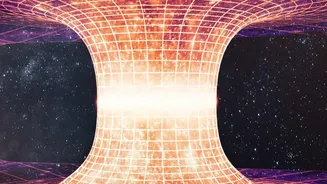
For decades, we've understood the universe to be about 13.8 billion years old. But what if it were nearly twice that age? A new study is challenging that foundational number, suggesting our cosmic history could stretch back 26.7 billion years.
The Universe's Established Age
The most
widely accepted theory in cosmology, the Lambda-CDM model, tells a clear story: our universe began 13.8 billion years ago with the Big Bang. Since then, it has been expanding and cooling. This age is calculated by measuring the expansion rate of the universe and tracing it backward to its starting point. It's a number that underpins everything we think we know about cosmic evolution, from how stars form to how galaxies are built. It has been tested and verified by countless observations, from the faint afterglow of the Big Bang (the cosmic microwave background) to the distribution of galaxies across the cosmos.
A Radical New Timeline Emerges
A study from University of Ottawa adjunct physics professor Rajendra Gupta proposes a dramatic revision to this timeline. Published in the Monthly Notices of the Royal Astronomical Society, his model calculates the universe's age to be 26.7 billion years old. This isn't just a minor tweak; doubling the age of the universe would fundamentally change our understanding of what happened in its earliest, most mysterious chapters. The proposal stems from an attempt to solve some nagging puzzles that have recently emerged in astronomy.
The 'Impossible' Galaxy Problem
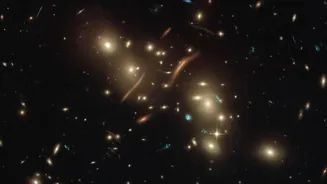
A key motivation for this new theory comes from data gathered by the James Webb Space Telescope (JWST). The powerful telescope has spotted galaxies in the early universe that are shockingly mature and massive. According to the standard 13.8-billion-year model, these galaxies, seen at a time just a few hundred million years after the Big Bang, shouldn't have had enough time to grow so large and complex. This has been dubbed the 'impossible early galaxy problem'. An older universe, however, would provide the necessary billions of years for these galaxies to form and evolve into the structures the JWST is observing.
Combining Old and New Ideas
Gupta's model, known as CCC+TL, achieves this older age by combining two concepts. The first is 'Covarying Coupling Constants' (CCC), a hypothesis that suggests the fundamental forces of nature might not be constant and could have changed over cosmic time. The second is a revival of a century-old idea called 'tired light' (TL). This theory, first proposed by Fritz Zwicky in 1929, suggests that light loses energy as it travels across vast cosmic distances. This energy loss would make light appear redder, a phenomenon known as redshift, which astronomers currently attribute almost entirely to the expansion of the universe. By treating redshift as a hybrid phenomenon—partly from expansion, partly from tired light—the timeline stretches significantly.
Does This Eliminate Dark Matter and Energy?
Interestingly, the CCC+TL model may also offer an explanation for cosmic observations without relying on dark matter and dark energy. In the standard model, these two invisible components are required to make the equations work and are thought to make up 95% of the universe. Dark matter provides the extra gravity needed to hold galaxies together, while dark energy explains the universe's accelerating expansion. Gupta suggests that the effects we attribute to dark matter and dark energy could instead be explained by the evolution of physical constants over 26.7 billion years. His model was able to explain the rotation of galaxies without invoking dark matter.
A Universe of Healthy Debate
It is crucial to understand that this is a provocative proposal, not a new consensus. The Lambda-CDM model remains the dominant framework in cosmology because it successfully explains a vast range of observations. The 'tired light' theory, in particular, has been largely dismissed by the scientific community in the past because it conflicted with certain observations. Gupta's hybrid model is an attempt to resolve those conflicts, but it stands outside of mainstream cosmology and will require significant independent testing and verification before it can be considered a viable alternative. Science progresses by challenging its own foundations, and this study is a perfect example of that process in action.