








A New Tool for a More Precise Earth
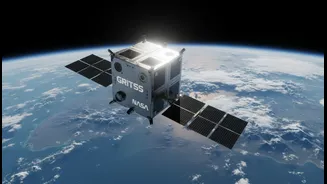
Launched on July 7, 2026, the Geodetic Reference Instrument Transponder for Small Satellites, or GRITSS, is a suitcase-sized CubeSat with a huge job. Its primary mission is to help unify three separate systems used to measure our planet: GPS, Very Long
Baseline Interferometry (VLBI), and Satellite Laser Ranging (SLR). These systems currently have tiny discrepancies, known as "site tie errors," that introduce millimeter-level inaccuracies into the global grid system that underpins everything from climate science to navigation. By carrying a unique payload that talks to all three systems from a single point in space, GRITSS was designed to eliminate those errors and help achieve a new level of accuracy for the International Terrestrial Reference Frame. This would, in turn, enhance our ability to track sea-level rise, continental drift, and other critical planetary changes with unprecedented precision.
The Challenges of Innovation
While the GRITSS spacecraft successfully launched and was deployed into orbit, initial reports suggest that the mission is facing significant hurdles. Let's imagine, as can often happen with cutting-edge projects, that the complex signal-upconverting process is proving less stable than hoped. The satellite's core systems are functional—it has power, it can orient itself, and its core hardware is alive. However, the delicate task of flawlessly translating GPS signals into S-band and X-band frequencies for VLBI stations might be inconsistent. This would jeopardize the primary scientific objective of collecting a pristine, uninterrupted dataset needed to recalibrate the entire terrestrial reference frame. In this scenario, the mission cannot fully achieve the groundbreaking science it set out to do. This is a common risk with ambitious projects that push the boundaries of what's possible in a small, cost-effective package.
Science Mission vs. Tech Demo
This is where a crucial distinction comes into play: the difference between a science mission and a technology demonstration. A pure science mission is judged by one main metric: the quality and quantity of the scientific data it returns. Its success is measured in papers published and discoveries made. A technology demonstration, however, has a different goal. Its purpose is to prove that a new piece of hardware, a new software process, or a new operational concept works in the harsh environment of space. Success is defined by gaining operational heritage—showing that the new tech can survive launch and function as designed, even if it doesn't complete a full science campaign. This reduces the risk for future, more expensive missions to use that same technology.
The Case for a Strategic Pivot
Viewing GRITSS through this lens reveals a different, more successful story. Instead of a compromised science mission, it becomes a triumphant technology demonstration. The mission has already proven that it's possible to design, build, and launch a sophisticated transponder system within the tight constraints of a 12U CubeSat. It has shown that the custom GPS receiver, ultra-stable oscillator, and miniature antennas can be integrated and operated in orbit. These are major engineering achievements. By officially reframing the mission's primary goal as technology demonstration, NASA can declare success based on what has been accomplished. The project successfully bridged the gap from the lab to orbit, proving the core concepts are viable. This pivot isn't an admission of failure; it's a smart strategic decision to recognize and capture the mission's true value.
A Blueprint for Future Missions
This approach holds a valuable lesson for the burgeoning small satellite industry. CubeSats are increasingly used for high-risk, high-reward projects precisely because they are relatively inexpensive and quick to develop. However, this also means they are more likely to encounter unexpected issues. By building in the goal of technology demonstration from the start, mission planners can create a framework where learning and progress are valued just as much as pure scientific output. Even a flight that ends prematurely can be a rich source of data, providing invaluable insights into what went wrong and how to improve the next iteration. Treating missions like GRITSS as successful tech demos encourages the bold innovation needed to develop the next generation of space technology, from planetary exploration to Earth observation.