



A Sweet Discovery in Deep Space
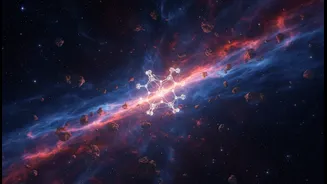
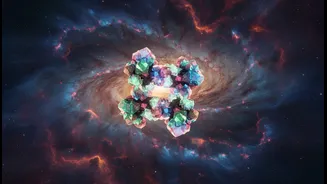
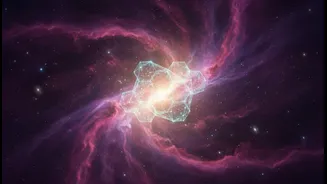
In a breakthrough for astrochemists, an international team of researchers has detected a sugar molecule floating in a giant cloud of gas and dust near the center of our Milky Way galaxy. The molecule, called erythrulose, is the first true sugar ever to
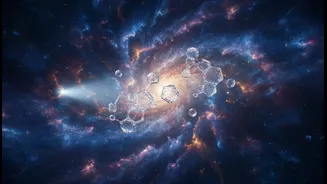
be identified directly in the vastness of interstellar space. On Earth, this four-carbon sugar is found in things like raspberries and is used in some self-tanning products. While erythrulose itself isn't a direct component of our DNA, its discovery is significant. It belongs to the same chemical family as the sugars that form the structural backbone of our genetic material. For decades, scientists have wondered how the building blocks of life first appeared on a barren, early Earth, as laboratory experiments simulating those conditions have struggled to produce these crucial molecules in sufficient quantities. Finding a complex sugar forming naturally in space suggests the ingredients for life may not have needed to form on Earth at all.
Searching for a Cosmic Fingerprint
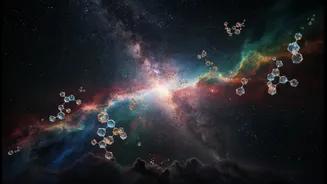
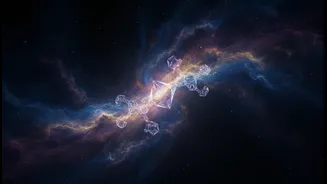
Detecting a specific molecule 27,000 light-years away is a monumental task. Scientists can't simply collect a sample. Instead, they use powerful radio telescopes to listen for the unique 'fingerprint' of a molecule. As molecules rotate in the cold vacuum of space, they emit faint radio signals at very specific frequencies. A team led by researchers at the Center for Astrobiology in Spain used telescopes in Spain to point at a molecular cloud known as G+0.693−0.027, a known hotspot for complex molecules. By comparing the signals from this cloud with the known radio signature of erythrulose measured in a lab, they found a definitive match—12 distinct spectral lines confirmed the sugar's presence. This discovery provides powerful evidence that the chemistry of the cosmos is complex enough to build the kinds of molecules essential for life.
The Primordial Delivery Service
So, how does a sugar in a cosmic cloud billions of kilometers away get to Earth? The leading theory is a kind of cosmic delivery service. The gas and dust clouds where erythrulose was found are the very same kind of nurseries where stars and planets form. Scientists believe that as our own solar system formed 4.6 billion years ago, these prebiotic molecules would have been incorporated into asteroids and comets. For millions of years, early Earth was relentlessly pelted by these objects during a period called the Late Heavy Bombardment. Researchers estimate that millions of tons of erythrulose could have been delivered to our planet's surface during this time. This influx of complex organic compounds, including sugars, amino acids, and nucleobases—the building blocks of proteins and DNA—could have seeded Earth's primordial oceans, providing the raw materials for the first life to emerge.
Not Just Any Sugar
While simpler sugar-like molecules had been found in space before, the discovery of erythrulose, a true four-carbon sugar, is a major step forward. It’s far more complex than previously detected molecules and shows that interstellar chemistry can create sophisticated structures. The discovery is particularly exciting because it provides a plausible pathway for the formation of even more critical sugars, like ribose (the 'R' in RNA) and 2-deoxyribose (the 'D' in DNA). In fact, separate laboratory experiments by NASA have already shown that 2-deoxyribose can be created by irradiating ice mixtures that mimic interstellar conditions. This suggests that the universe is a proficient organic chemist, capable of producing a wide array of life's ingredients. The presence of erythrulose in space strongly supports the idea that the chemical toolkit for life is not unique to Earth but is widespread throughout the galaxy.
What Comes Next in the Search for Life's Origins?
This discovery does not prove how life started, but it provides a critical piece of the puzzle. It strengthens the theory that life may have emerged from a soup of cosmic ingredients delivered from space. The next steps for scientists are clear. Researchers will now use powerful telescopes to search for even more complex sugars, especially ribose, in other molecular clouds. The detection of ribose would be another massive leap forward, as RNA is believed by many to have preceded DNA as the primary genetic material in early life forms. Furthermore, missions to retrieve samples from asteroids, like Japan's Hayabusa2, will allow scientists to search for these sugars directly in pristine cosmic material. Each new discovery brings us closer to understanding not only how life began on our planet, but also whether the conditions for life might exist elsewhere in the vast cosmic ocean.