

What Is a Solar Storm?
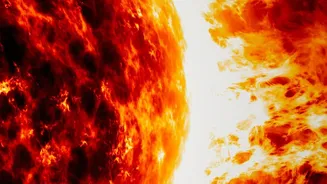
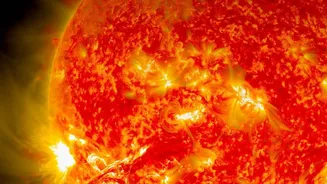
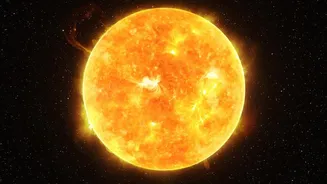
A solar storm is a powerful disturbance on the sun. Think of it as the sun having a bout of violent weather. These events can manifest in several ways, most notably as solar flares or coronal mass ejections (CMEs). A solar flare is an enormous explosion
in the sun's atmosphere, releasing a massive burst of electromagnetic radiation. A CME, often associated with flares, is an even larger event where the sun expels a huge cloud of magnetized plasma into space. While Earth’s magnetic field protects us from most of this, a particularly strong, Earth-directed storm can have serious consequences for our technology-dependent society.
The Threat to Our Digital World
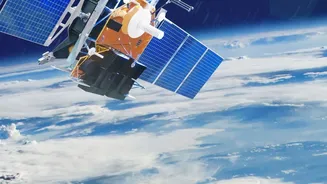
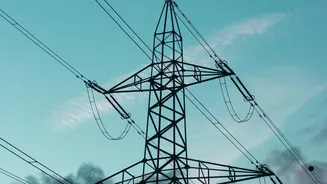
Our interconnected world runs on systems that are highly vulnerable to space weather. For satellites that handle everything from GPS navigation to global communications, a solar storm can be devastating. Bursts of high-energy particles can damage sensitive electronics and disrupt signals. The increased atmospheric drag from a storm can even cause low-orbiting satellites to fall. On Earth, the primary danger is to our power grids. A geomagnetic storm, which occurs when a CME interacts with Earth's magnetic field, can induce powerful currents in long transmission lines. These geomagnetically induced currents can overload transformers and other critical components, potentially leading to widespread and long-lasting blackouts. A severe storm today could impact everything from supply chains to emergency services.
Our Eyes on the Sun
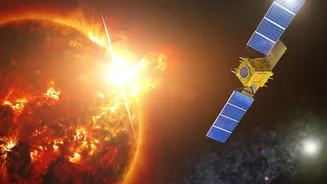
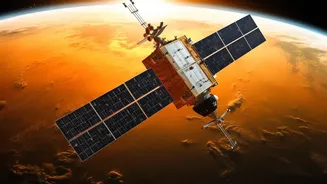
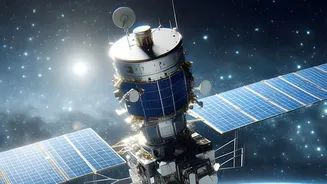
The headline's "shield" isn't a physical barrier but an incredibly sophisticated early warning system. Agencies like the US-based National Oceanic and Atmospheric Administration (NOAA) use a fleet of satellites to constantly monitor the sun. Key among these are spacecraft positioned at a special location 1.5 million kilometres from Earth called Lagrange Point 1 (L1). From this vantage point, satellites like the Deep Space Climate Observatory (DSCOVR) and the Solar and Heliospheric Observatory (SOHO) get an uninterrupted view of the sun. They can spot a CME as it leaves the sun, giving forecasters crucial time—from many hours to a few days—to predict if it will hit Earth.
From Warning to Action
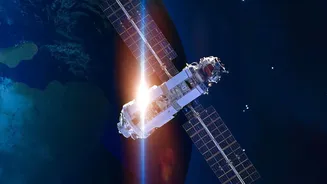
Once an alert is issued by a forecasting centre like NOAA's Space Weather Prediction Center (SWPC), asset operators can take protective measures. This is where the 'shielding' truly happens. Power grid operators can prepare their systems by adjusting loads or temporarily taking certain equipment offline to prevent overload from induced currents. Satellite operators can put their spacecraft into a 'safe mode,' shutting down non-essential and vulnerable electronics until the storm passes. Airlines that fly polar routes, where Earth's magnetic protection is weaker, may reroute flights to lower latitudes to protect crew, passengers, and communication systems from increased radiation.
A United Front Against the Sun
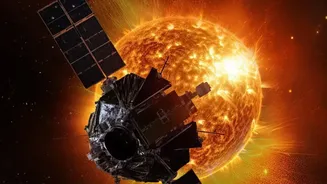
Monitoring space weather is a global endeavour. No single nation can do it alone. International cooperation is vital, with agencies from across the world sharing data and forecasts. India has become a key player in this effort with its Aditya-L1 mission. Launched by ISRO, Aditya-L1 is also positioned at the L1 point, providing another set of eyes on the sun to study solar dynamics and improve space weather predictions. By contributing its data, Aditya-L1 enhances the global network, helping to safeguard not just India's assets but the world's technological infrastructure from solar threats.